Benzyl 4-(1,2,4-triazol-1-yl)butyrate → 4-(1H-1,2,4-triazol-1-yl)butanoic acid
Reaction equation
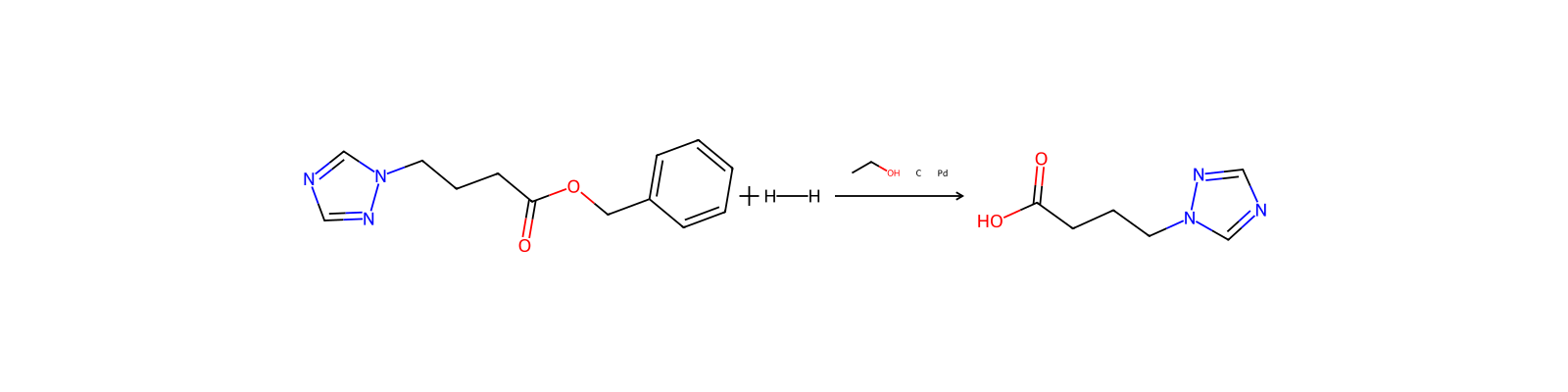
[N:1]1([CH2:6][CH2:7][CH2:8][C:9]([O:11]CC2C=CC=CC=2)=[O:10])[CH:5]=[N:4][CH:3]=[N:2]1.[H][H]>C(O)C.[C].[Pd]>[N:1]1([CH2:6][CH2:7][CH2:8][C:9]([OH:11])=[O:10])[CH:5]=[N:4][CH:3]=[N:2]1Participants
5





Procedure
0.5 g of 5% palladium carbon was added to a solution of 11 g of benzyl 4-(1,2,4-triazol-1-yl)butyrate in 150 ml of ethanol. The mixture was stirred at a hydrogen pressure of 1 atm. at room temperature for 1 hour. Thereto was added 100 ml of ethanol. The mixture was heated and made uniform. Palladium carbon was collected by filtration and washed with ethanol. The filtrate and the washings were combined and concentrated under reduced pressure. To the residue was added a small amount of ethanol. The resulting insolubles were collected by filtration to obtain 6.2 g of 4-(1,2,4-triazol-1-yl)butyric acid as a white powder.
Workup
- temperatureThe mixture was heated
- filtrationPalladium carbon was collected by filtration
- washwashed with ethanol
- concentrationconcentrated under reduced pressure
- additionTo the residue was added a small amount of ethanol
- filtrationThe resulting insolubles were collected by filtration
Sources & evidence
- ORD record
- ord-ccdf7e8b89a84c3c9ad0aee7e10f3855
- Source dataset
- uspto-grants-2000_10
- Patent number
- US06136826
Reaction notes
Loading…