ethyl (S)-3-[2-(tert-butoxycarbonylamino)-1,2,3,4-tetrahydronaphthalen-7-yl]acrylate → ethyl (S)-3-[2-(tert-butoxycarbonylamino)-1,2,3,4-tetrahydronaphthalen-7-yl]propionate
Reaction equation
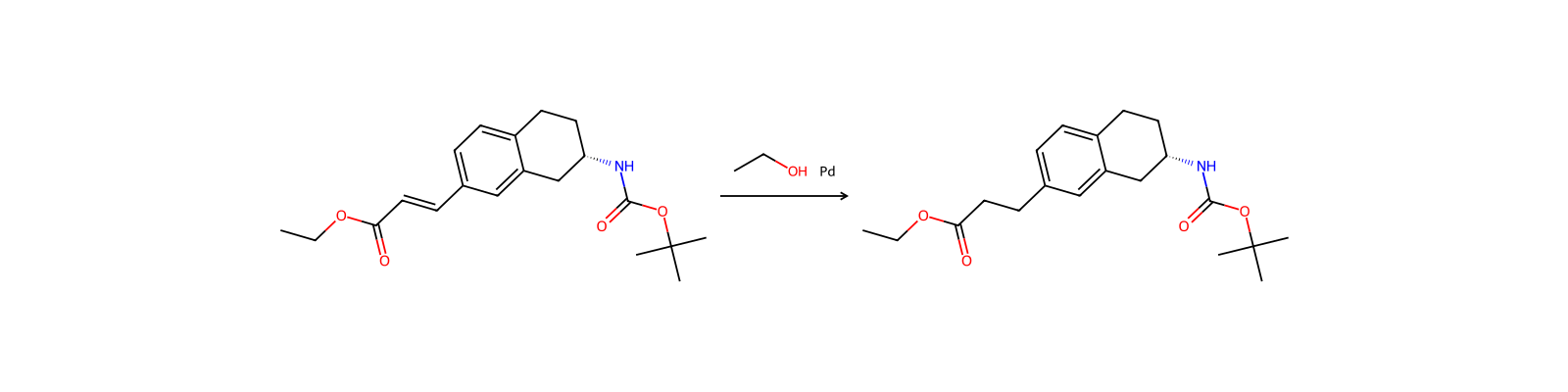
[C:1]([O:5][C:6]([NH:8][C@H:9]1[CH2:18][CH2:17][C:16]2[C:11](=[CH:12][C:13]([CH:19]=[CH:20][C:21]([O:23][CH2:24][CH3:25])=[O:22])=[CH:14][CH:15]=2)[CH2:10]1)=[O:7])([CH3:4])([CH3:3])[CH3:2]>C(O)C.[Pd]>[C:1]([O:5][C:6]([NH:8][C@H:9]1[CH2:18][CH2:17][C:16]2[C:11](=[CH:12][C:13]([CH2:19][CH2:20][C:21]([O:23][CH2:24][CH3:25])=[O:22])=[CH:14][CH:15]=2)[CH2:10]1)=[O:7])([CH3:4])([CH3:3])[CH3:2]Participants
4
Reactant 1

Product 1

Reagents, catalysts & solvents 2


Procedure
Ethyl (S)-3-[2-(tert-butoxycarbonylamino)-1,2,3,4-tetrahydronaphthalen-7-yl]acrylate (252 mg) was dissolved in ethanol (10 ml), and 10% palladium on activated carbon (30 mg) was added to the solution, then the resulting mixture was stirred for 3 hours at room temperature under a hydrogen atmosphere. The reaction mixture was filtrated to remove the catalyst, and the filtrate was concentrated in vacuo. Recrystallization of the residue from diisopropyl ether gave ethyl (S)-3-[2-(tert-butoxycarbonylamino)-1,2,3,4-tetrahydronaphthalen-7-yl]propionate (236 mg) having a melting point of 101-102° C.
Workup
- filtrationThe reaction mixture was filtrated
- customto remove the catalyst
- concentrationthe filtrate was concentrated in vacuo
- customRecrystallization of the residue from diisopropyl ether
Sources & evidence
- ORD record
- ord-ad8eb74a1fc441049743cdce49988132
- Source dataset
- uspto-grants-2000_10
- Patent number
- US06136852
Reaction notes
Loading…