Sodium Acetate → 3-(2-Methylbenzoyl)-5,6,7,8-tetrahydro-2-naphthol
Reaction equation
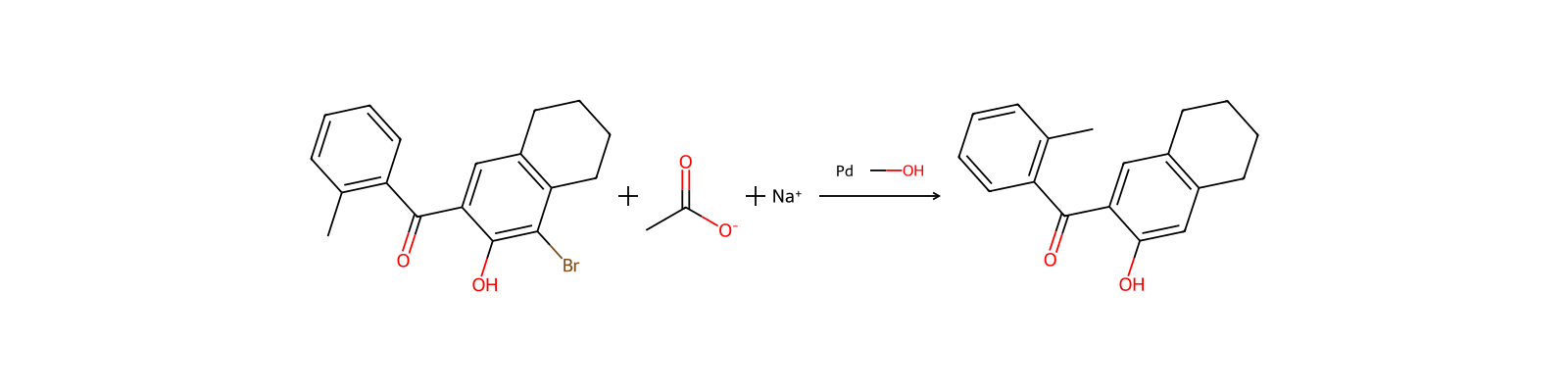
Br[C:2]1[C:11]2[CH2:10][CH2:9][CH2:8][CH2:7][C:6]=2[CH:5]=[C:4]([C:12](=[O:20])[C:13]2[CH:18]=[CH:17][CH:16]=[CH:15][C:14]=2[CH3:19])[C:3]=1[OH:21].C([O-])(=O)C.[Na+]>[Pd].CO>[CH3:19][C:14]1[CH:15]=[CH:16][CH:17]=[CH:18][C:13]=1[C:12]([C:4]1[C:3]([OH:21])=[CH:2][C:11]2[CH2:10][CH2:9][CH2:8][CH2:7][C:6]=2[CH:5]=1)=[O:20]Participants
5




Procedure
A mixture of 1-bromo-3-(2-methylbenzoyl)-5,6,7,8-tetrahydro-2-naphthol (3.33 g), sodium acetate (0.82 g), 5% palladium-on-carbon (50% hydrate, 1.0 g) and methanol (10 ml) was subjected to catalytic reduction. After the theoretical amount of hydrogen had been absorbed, the catalyst was filtered off. The solvent was then distilled off and the residue was diluted with water and extracted with ethyl acetate. The extract was washed with water and dried (MgSO4) and the solvent was distilled off to give 3-(2-methylbenzoyl)-5,6,7,8-tetrahydro-2-naphthol as an oil (2.45 g, 96.5%).
Workup
- customAfter the theoretical amount of hydrogen had been absorbed
- filtrationthe catalyst was filtered off
- distillationThe solvent was then distilled off
- additionthe residue was diluted with water
- extractionextracted with ethyl acetate
- washThe extract was washed with water
- dry with materialdried (MgSO4)
- distillationthe solvent was distilled off
Sources & evidence
- ORD record
- ord-19b17b6c1f674e2c8896c8981d492d84
- Source dataset
- uspto-grants-1995_05
- Patent number
- US05418239
Reaction notes
Loading…