Pyridinium chloride → HCID 19936463, compound
Reaction equation
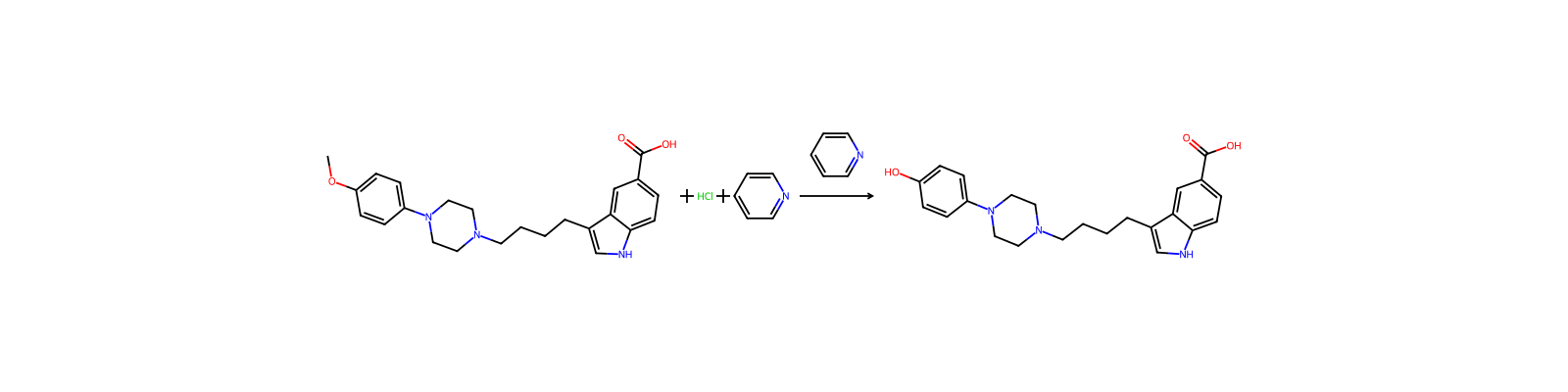
C[O:2][C:3]1[CH:8]=[CH:7][C:6]([N:9]2[CH2:14][CH2:13][N:12]([CH2:15][CH2:16][CH2:17][CH2:18][C:19]3[C:27]4[C:22](=[CH:23][CH:24]=[C:25]([C:28]([OH:30])=[O:29])[CH:26]=4)[NH:21][CH:20]=3)[CH2:11][CH2:10]2)=[CH:5][CH:4]=1.Cl.N1C=CC=CC=1>N1C=CC=CC=1>[OH:2][C:3]1[CH:8]=[CH:7][C:6]([N:9]2[CH2:10][CH2:11][N:12]([CH2:15][CH2:16][CH2:17][CH2:18][C:19]3[C:27]4[C:22](=[CH:23][CH:24]=[C:25]([C:28]([OH:30])=[O:29])[CH:26]=4)[NH:21][CH:20]=3)[CH2:13][CH2:14]2)=[CH:5][CH:4]=1Participants
4
Reactant 2


Product 1

Reagents, catalysts & solvents 1

Procedure
A mixture of 4 g of 3-[4-(4-p-methoxyphenylpiperazino)butyl]indole-5-carboxylic acid, 3.2 g of pyridine hydrochloride and 80 ml of pyridine is boiled for 3 hours. It is cooled, evaporated and worked up in a conventional manner, and 3-[4-(4-p-hydroxyphenylpiperazino)butyl]indole-5-carboxylic acid is obtained.
Workup
- temperatureIt is cooled
- customevaporated
Sources & evidence
- ORD record
- ord-40113b753d014ea0bfb834b34d4997e3
- Source dataset
- uspto-grants-1995_05
- Patent number
- US05418237
Reaction notes
Loading…