HuagongsheHuagongshe Chemistry Print Report · For research reference only
HRID 369581Generated: October 28, 2026
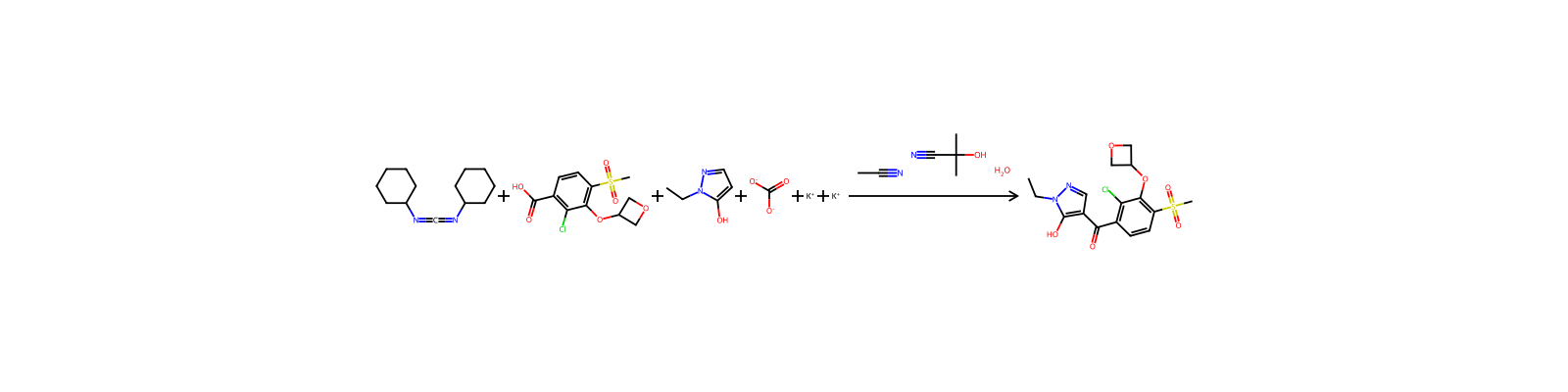
Dicyclohexylcarbodiimide → HCID 178463132, compound
https://huagongshe.com/reaction/369581
Participants
| Role | Name | HCID | Charge |
|---|
| Reactant | Dicyclohexylcarbodiimide | HCID 10868 | — |
| Reactant | Potassium Carbonate | HCID 11430 | — |
| Reactant | 2-Chloro-4-methylsulfonyl-3-(3-oxetanyloxy)benzoic acid | HCID 23282342 | — |
| Reactant | HCID 178418331 | HCID 178418331 | — |
| Catalyst | Acetone Cyanohydrin | HCID 6406 | — |
| Solvent | Water | HCID 962 | — |
| Solvent | Acetonitrile | HCID 6342 | — |
| Product | HCID 178463132 | HCID 178463132 | — |
Reaction Steps
Dicyclohexylcarbodiimide (0.72 g (3.5 mmol) was added at ambient temperature with stirring to a solution of 1.07 g (3.5 mmol) of 2-chloro-4-methylsulfonyl-3-(3-oxetanyloxy)benzoic acid and 0.45 g (4 mmol) of 1-ethyl-5-hydroxypyrazole in 25 mL of dry acetonitrile. The mixture was allowed to react for about one hour and then was filtered. The solids collected were extracted with dry acetonitrile. The filtrate and extract were combined and 0.69 g (5.0 mmol) of potassium carbonate and a few drops of acetone cyanohydrin were added with stirring at ambient temperature. The mixture was stirred overnight and was then poured into water. The resulting solution was extracted with ether and then acidified with aqueous hydrochloric acid. The mixture obtained was extracted three times with dichloromethane and the three extracts were combined, washed with water, dried over magnesium sulfate, and concentrated by evaporation under reduced pressure. The yellow solid residue was recrystallized from ethanol to obtain 0.77 g (55 percent of theory) of the title compound as a nearly colorless solid melting at 206-2080° C.
Provenance & Evidence
| DOI | 10.6084/m9.figshare.5104873.v1 |
|---|
| Patent number | US06140271 |
|---|
| Source dataset | uspto-grants-2000_10 |
|---|
| ORD ID | ord-498d8e3dc611407d9a3a068c47567876 |
|---|
| Source note | uspto-grants-2000_10 |
|---|