Dichloromethane → 1H-Imidazole-5-methanol, 2-butyl-1-[(2-chlorophenyl)methyl]-
Reaction equation
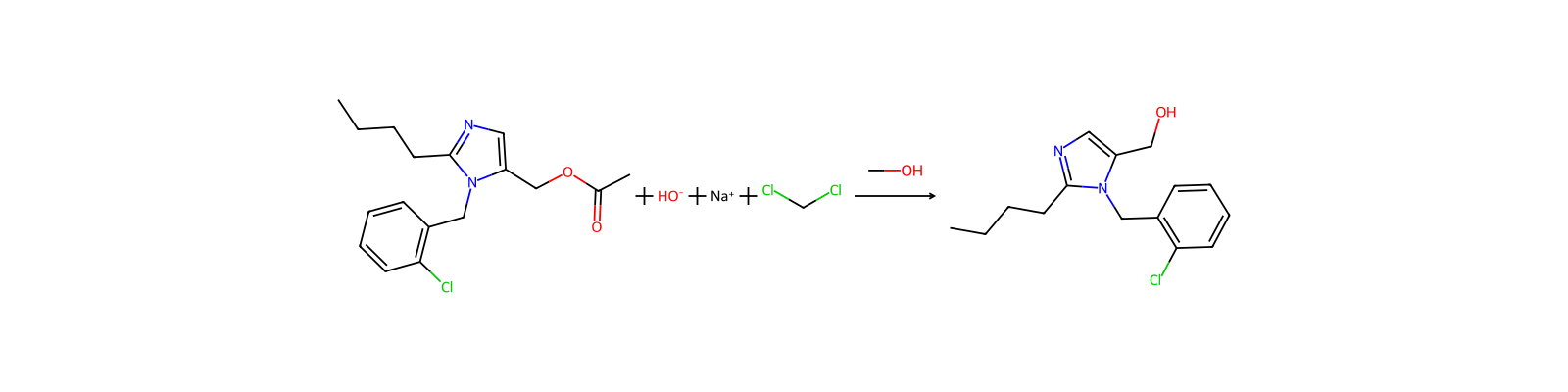
[CH2:1]([C:5]1[N:6]([CH2:15][C:16]2[CH:21]=[CH:20][CH:19]=[CH:18][C:17]=2[Cl:22])[C:7]([CH2:10][O:11]C(=O)C)=[CH:8][N:9]=1)[CH2:2][CH2:3][CH3:4].[OH-].[Na+].C(Cl)Cl>CO>[CH2:1]([C:5]1[N:6]([CH2:15][C:16]2[CH:21]=[CH:20][CH:19]=[CH:18][C:17]=2[Cl:22])[C:7]([CH2:10][OH:11])=[CH:8][N:9]=1)[CH2:2][CH2:3][CH3:4]Participants
5





Procedure
A solution of crude 2-n-butyl-5-acetoxymethyl-1-(2-chlorophenyl)methyl-1H-imidazole (250 g) in methanol (200 mL) was treated with 10% sodium hydroxide solution (700 mL) and the mixture was heated on a steam bath for 4 hours. After cooling, methylene chloride was added, the organic phase was separated, washed with water, dried and concentrated. The residue was dissolved in ether, cooled, and seeded to give the crude product. Recrystallization from ethyl acetate gave 176 g of 2-n-butyl-1-(2-chlorophenyl)methyl-5-hydroxymethyl-1H-imidazole; mp 86°-88° C. This material was identical in all respects to the product prepared by Method 1.
Workup
- temperaturethe mixture was heated on a steam bath for 4 hours
- temperatureAfter cooling
- customthe organic phase was separated
- washwashed with water
- customdried
- concentrationconcentrated
- dissolutionThe residue was dissolved in ether
- temperaturecooled
- customto give the crude product
- customRecrystallization from ethyl acetate
Sources & evidence
- ORD record
- ord-3ae0993febb845fe8c83228d0895cdb2
- Source dataset
- uspto-grants-1995_05
- Patent number
- US05418250
Reaction notes
Loading…