Lithium Carbonate → Zinc Oxide
Reaction equation

[O-2:1].[Zn+2:2].C(=O)([O-])[O-:4].[Li+:7].[Li+:8].[O-2].[V+5:10].[O-2].[O-2].[O-2].[O-2].[V+5]>>[O-2:4].[Zn+2:2].[O:1]([Li:8])[Li:7].[O-2:4].[V+5:10].[O-2:4].[O-2:4].[O-2:4].[O-2:4].[V+5:10]Participants


Procedure
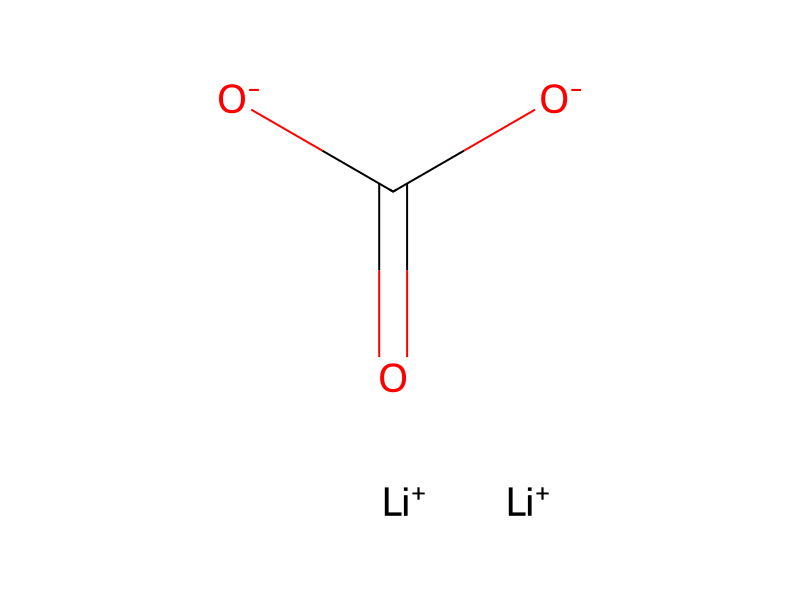
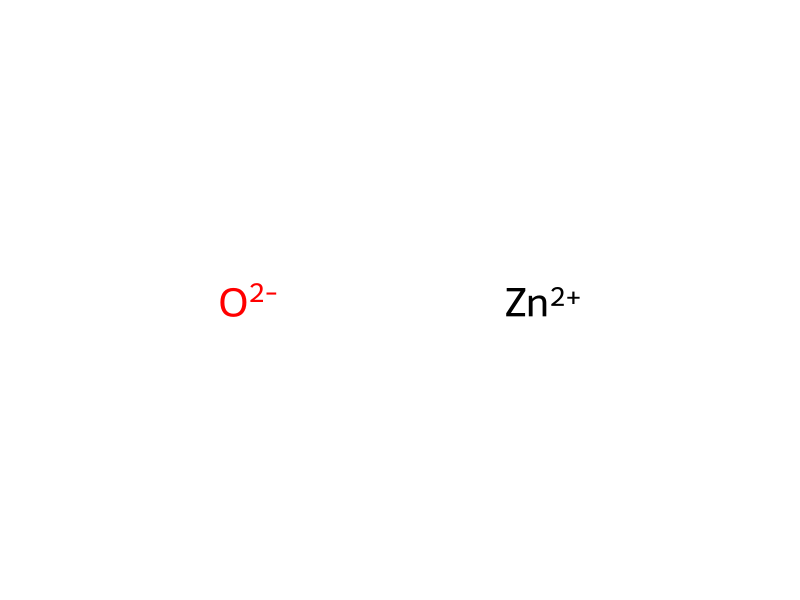
The humidity-sensitive element in accordance with the present invention is produced in the following manner. First, fine powders of chromic oxide (Cr2O3), zinc oxide (Cr2O3), cupric oxide (CuO), lithium carbonate (Li2CO3) and vanadium oxide (V2O5) are used as starting materials. The starting materials were weighed so as to give Cr2O3, ZnO, CuO, Li2O, V2O5 mol ratios of 45%, 45%, 4%, 3% and 3%, respectively. The materials are then wet-mixed for 24 hours in a ball mill. After wet-mixing, the mixture is dried for 12 hours at 120° C. and then calcined at 800° C. The calcined material is pulverized for 24 hours in a ball mill and is dried again for 12 hours at 120° C. to form a powder. Next, 2 wt.% of polyvinyl alcohol is added to the powder as a binder. The mixture is then granulated in a granulating machine. The granulated material is then formed under 500 kg/cm2 of pressure into a disc with a diameter of approximately 8 mm and a thickness of approximately 2 mm to form the body of the element. The disc is then sintered for 2 hours at a temperature of 1300° C. A ruthenium oxide paste is then screen-printed in a lattice-shaped configuration on each surface of the body to form the electrodes. The body is then heated to approximately 700° C. Thus a humidity-sensitive element is formed in accordance with the present invention.
Workup
- customThe humidity-sensitive element in accordance with the present invention is produced in the following manner
Sources & evidence
- ORD record
- ord-d6cc951d85dd4ba6b5b1c27fb57cc6ba
- Source dataset
- uspto-grants-1985_07
- Patent number
- US04529540
Reaction notes
Loading…