Bromine → 6-(4-Chlorophenyl)-2,3-dihydropyridazin-3-one
Reaction equation

[Cl:1][C:2]1[CH:7]=[CH:6][C:5]([C:8]2[CH2:9][CH2:10][C:11](=[O:14])[NH:12][N:13]=2)=[CH:4][CH:3]=1.BrBr>C(O)(=O)C>[Cl:1][C:2]1[CH:7]=[CH:6][C:5]([C:8]2[CH:9]=[CH:10][C:11](=[O:14])[NH:12][N:13]=2)=[CH:4][CH:3]=1Participants
Reactant 2

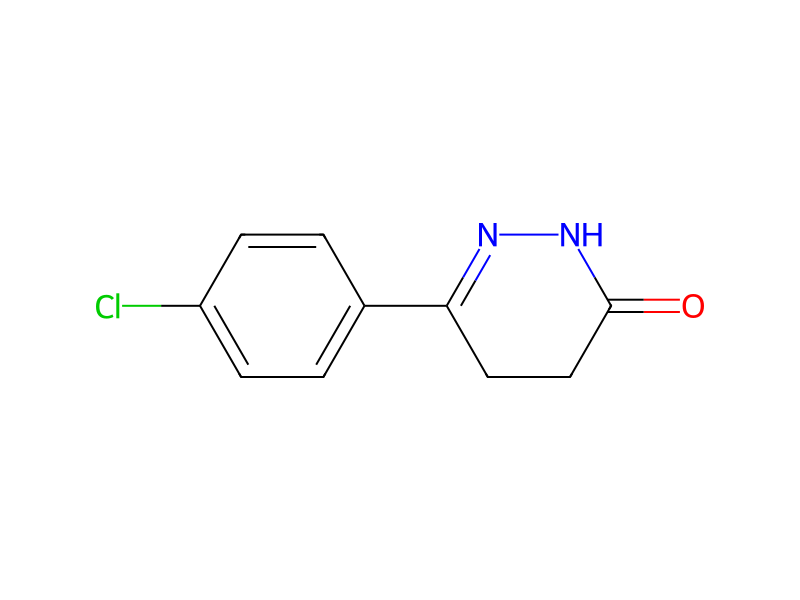
Product 1

Reagents, catalysts & solvents 1

Procedure
A 283 g. portion of 6-(p-chlorophenyl)-4,5-dihydro-3(2H)-pyridazinone (prepared as described in Example 1 of U.S. Pat. No. 3,689,652) is suspended in 2500 ml. of acetic acid at room temperature with stirring. A 227 g. (72.7 ml.) portion of bromine is dissolved in 300 ml. of acetic acid and 20% of this solution is added to the reaction mixture which is then heated on a steam bath until the bromine color disappears. The balance of the bromine solution is added portionwise, over a 1/2 hour period to the heated solution. The reaction mixture is heated for an additional hour and then poured into crushed ice. The resulting solid is recovered by filtration, washed with water and dried yielding an off-white solid, m.p. 269°-272° C., 6-(p-chlorophenyl)-3(2H)-pyridazinone.
Workup
- temperatureThe reaction mixture is heated for an additional hour
- additionpoured
- custominto crushed ice
- filtrationThe resulting solid is recovered by filtration
- washwashed with water
- customdried
Sources & evidence
- ORD record
- ord-863ad707d98c4ca9b0b4fdd9bb46a829
- Source dataset
- uspto-grants-1978_05
- Patent number
- US04092311
Reaction notes
Loading…