1,4-Dibromobenzene → Tetraethyl 1,4-phenylenebisphosphonate
Reaction equation

Br[C:2]1[CH:7]=[CH:6][C:5](Br)=[CH:4][CH:3]=1.C([O:11][P:12]([O:16][CH2:17][CH3:18])[O:13][CH2:14][CH3:15])C>Cl[Ni]Cl>[CH2:14]([O:13][P:12]([C:2]1[CH:7]=[CH:6][C:5]([P:12]([O:13][CH2:14][CH3:15])(=[O:11])[O:16][CH2:17][CH3:18])=[CH:4][CH:3]=1)(=[O:11])[O:16][CH2:17][CH3:18])[CH3:15]Participants
Reactant 2

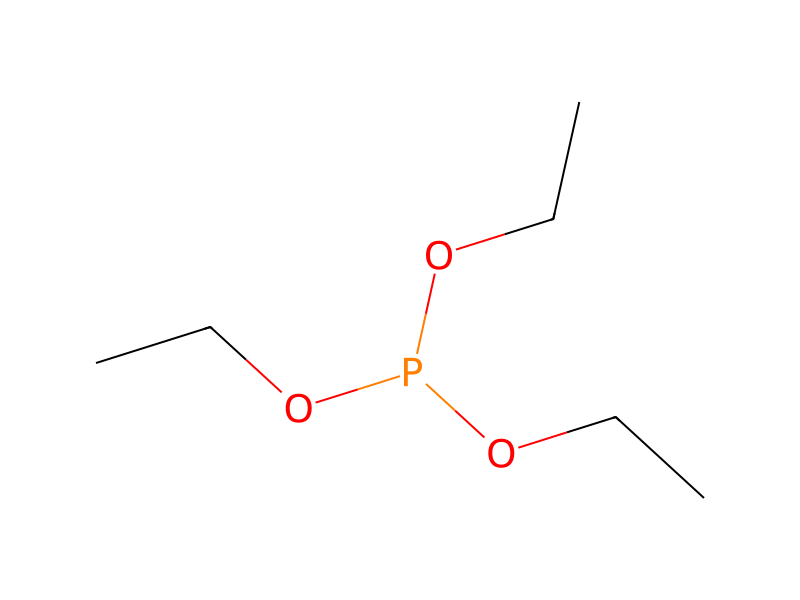
Product 1

Reagents, catalysts & solvents 1

Conditions
- Temperature
- 170 °C
Procedure
10 g (42 mmoles) of 1,4-dibromo-benzene and 600 mg of anhydrous NiCl2 are placed in a two-necked 250 ml flask which has a cooler, dripper funnel and magnetic agitation. 17.6 ml (100 mmoles) of triethyl-phosphite are added to the mixture dropwise and heated to 170° C. in an oil bath. The mixture is left under agitation at 170° C. for 2 hours, it is then cooled to 100° C. and subjected to vacuum distillation (1 mm Hg) to eliminate the excess triethyl-phosphite. The residue solubilized in 10 ml of ethanol undergoes chromatography on a silica column (5×56 cm) eluting first with 4 liters of a 95:5 ethyl-acetate/ethanol mixture and then with 3 liters of a 90:10 ethyl-acetate/ethanol mixture. 6.0 g (17.4 mmoles) of 1,4-benzene-diphosphonic acid tetra-ethyl ester are obtained with a molar yield of 41%.
Workup
- temperatureit is then cooled to 100° C.
- distillationsubjected to vacuum distillation (1 mm Hg)
- washeluting first with 4 liters of a 95:5 ethyl-acetate/ethanol mixture
Sources & evidence
- ORD record
- ord-8d53c7bb754048d0be37ac8a841fa866
- Source dataset
- uspto-grants-1992_11
- Patent number
- US05166380
Reaction notes
Loading…