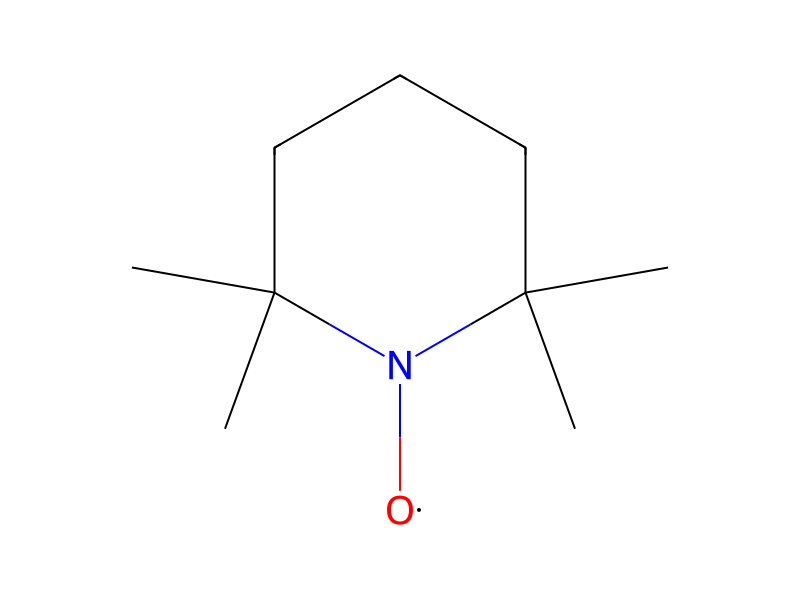
Tempo → 4-(Benzyloxy)-2,5-dimethylbenzaldehyde
Reaction equation

[CH3:1][C:2]1[CH:7]=[C:6]([O:8][CH2:9][C:10]2[CH:15]=[CH:14][CH:13]=[CH:12][CH:11]=2)[C:5]([CH3:16])=[CH:4][C:3]=1[CH2:17][OH:18].CC1(C)N([O])C(C)(C)CCC1>CN(C)C=O>[CH3:1][C:2]1[CH:7]=[C:6]([O:8][CH2:9][C:10]2[CH:15]=[CH:14][CH:13]=[CH:12][CH:11]=2)[C:5]([CH3:16])=[CH:4][C:3]=1[CH:17]=[O:18]Participants
Reactant 2

Product 1

Reagents, catalysts & solvents 1

Procedure
A mixture of 11.0 g (46 mmol) of 2,5-dimethyl-4-(phenylmethoxy)benzenemethanol (Example I), 0.4 g (0.05×46=2.3 mmol) of TEMPO (tetramethyl-1-piperidinyloxy, free radical) (Aldrich) and 0.2 g (2.3 mmol) of cuprous chloride in 150 mL of dimethylformamide is stirred vigorously under an atmosphere of oxygen (maintained by a balloon) at ambient temperature for 18 hours overnight. The heterogeneous mixture is (dark green) filtered through a pad of celite, washed with diethyl ether and the solvents are removed on a rotary evaporator. The residue is dissolved in diethyl ether and the solution is washed with 2×50 mL of 2N hydrochloric acid solution, brine, dried (magnesium sulfate) and evaporated leaving 10.7 g of a yellow viscous residue. Distillation of the product through a short path apparatus affords 10.3 g of a pale yellow distillate, bp 156°-8° C./0.50 (175°-180° C.) on standing the product crystallizes; mp 48°-49° C.
Workup
- filtrationfiltered through a pad of celite
- washwashed with diethyl ether
- customthe solvents are removed on a rotary evaporator
- dissolutionThe residue is dissolved in diethyl ether
- washthe solution is washed with 2×50 mL of 2N hydrochloric acid solution, brine
- dry with materialdried (magnesium sulfate)
- customevaporated
Sources & evidence
- ORD record
- ord-722ddb08046a48eaad5ac2a17274aca7
- Source dataset
- uspto-grants-1992_11
- Patent number
- US05166398
Reaction notes
Loading…