Phenacyl bromide → HCID 16688854, compound
Reaction equation

[CH2:1]([S:9][CH3:10])[CH2:2][CH2:3][CH2:4][CH2:5][CH2:6][CH2:7][CH3:8].[CH2:11](Br)[C:12]([C:14]1[CH:19]=[CH:18][CH:17]=[CH:16][CH:15]=1)=[O:13].[F:21][Sb-:22]([F:27])([F:26])([F:25])([F:24])[F:23].[Na+]>CC(C)=O>[F:21][Sb-:22]([F:27])([F:26])([F:25])([F:24])[F:23].[CH3:10][S+:9]([CH2:1][CH2:2][CH2:3][CH2:4][CH2:5][CH2:6][CH2:7][CH3:8])[CH2:11][C:12]([C:14]1[CH:19]=[CH:18][CH:17]=[CH:16][CH:15]=1)=[O:13]Participants
Reactant 3
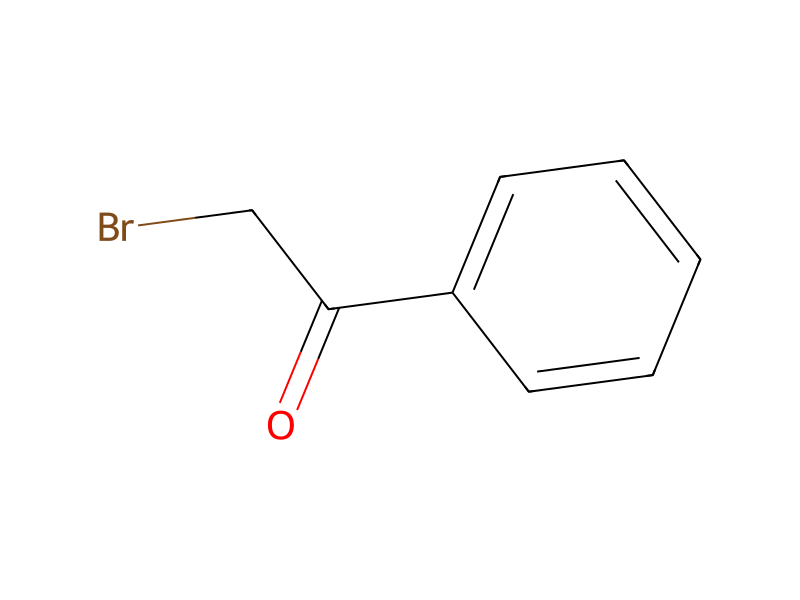


Product 1

Reagents, catalysts & solvents 1

Procedure
Into a 100 mL round bottom flask equipped with a magnetic stirrer and reflux condenser were placed 16.0 g (0.1 mol) methyl octyl sulfide (obtained from the Aldrich Chemical Co.), 19.9 g (0.1 mol) phenacyl bromide, 25.87 g (0.1 mol) sodium hexafluoroantimonate and 40 mL acetone. The reaction mixture was brought to reflux and held at this temperature for 15 minutes. The mixture was filtered through a plug of glass wool (to remove the sodium bromide which was formed during the reaction) and the solvent was removed on a rotary evaporator, leaving 43.1 g (83.6% yield) of the desired methyl octylphenacylsulfonium hexafluoroantimonate as a tan colored solid. The product was further purified by recrystallization, first from a 1:3 mixture of water and ethanol, then, isopropanol. The pure, colorless, crystalline initiator had a melting point of 75-76° C. The initiator was soluble in a wide variety of common solvents such as acetone, methyl ethyl ketone, chloroform and methylene chloride.
Workup
- customInto a 100 mL round bottom flask equipped with a magnetic stirrer
- temperaturereflux condenser
- customobtained from the Aldrich Chemical Co
- temperatureto reflux
- filtrationThe mixture was filtered through a plug of glass wool (
- customto remove the sodium bromide which
- customwas formed during the reaction) and the solvent
- customwas removed on a rotary evaporator
Sources & evidence
- ORD record
- ord-375022e9429445c7b876d2db2d6dc90f
- Source dataset
- uspto-grants-2000_02
- Patent number
- US06031014
Reaction notes
Loading…