1,3-Propanediol → 1,3-Propanediol
Reaction equation

[OH:1][CH2:2][CH2:3][CH:4]=[O:5].[CH2:6]([OH:10])[CH2:7][CH2:8][OH:9]>>[OH:5][CH2:4][CH2:3][CH:2]=[O:1].[CH2:6]([OH:10])[CH2:7][CH2:8][OH:9].[OH:5][CH2:4][CH2:3][CH:2]1[O:9][CH2:8][CH2:7][CH2:6][O:1]1Participants
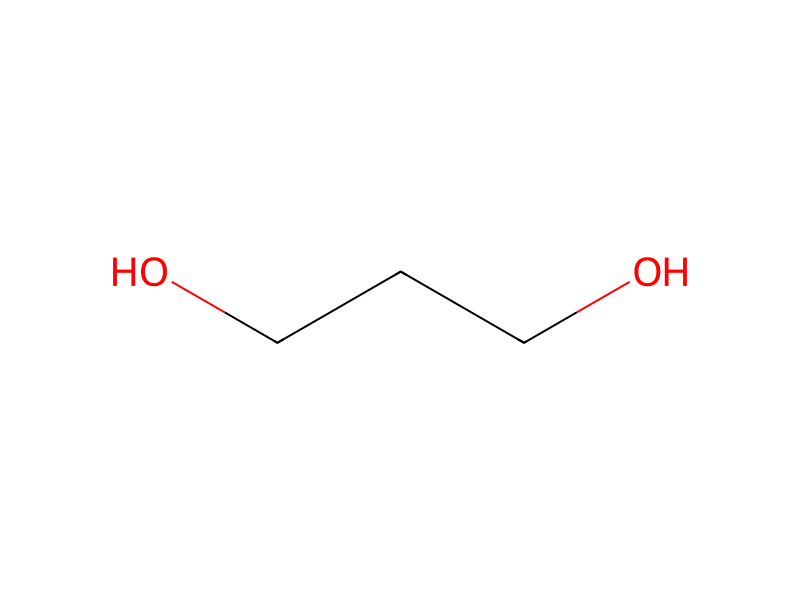


Procedure
When hydrogenating 3-hydroxypropanal to 1,3-propanediol on a large industrial scale, it is vital, with regard to the economic viability of the hydrogenation process and the quality of the product, for conversion and selectivity to be as close as possible to 100%. The 1,3-propanediol may be separated from the water as well as remaining 3-hydroxypropanal and secondary products contained in the product stream by distillation after the hydrogenation. However, this distillative separation is rendered very difficult by residual 3-hydroxypropanal and secondary products and may even become impossible due to reactions between the residual 3-hydroxypropanal and 1,3-propanediol to yield acetals such as 2-(2′-hydroxyethyl)-1,3-dioxane (HED), which have a boiling point close to the boiling point of 1,3-propanediol. Thus, the lower the conversion and selectivity, the poorer the achievable product quality.
Workup
- customas close as possible to 100%
- customThe 1,3-propanediol may be separated from the water as well
- distillationcontained in the product stream by distillation after the hydrogenation
- customHowever, this distillative separation
Sources & evidence
- ORD record
- ord-464ddb1f40f3485388c46fb68041527a
- Source dataset
- uspto-grants-2001_10
- Patent number
- US06297408B1
Reaction notes
Loading…