Succinic Acid → Urea
Reaction equation

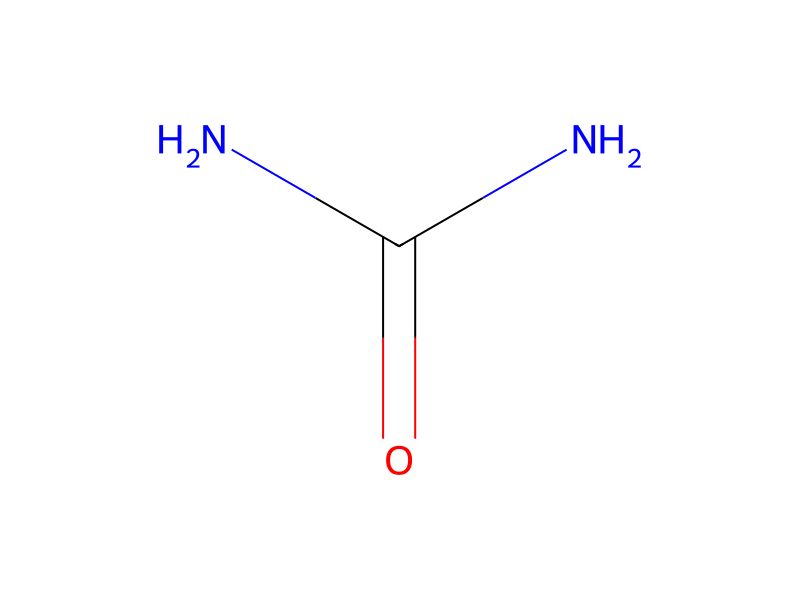
[C:1]1(=[O:15])[N:5]([CH:6]([CH2:10]C(O)=O)[C:7](O)=O)C(=O)CC1.C1(=O)[N:20]([CH:21]([CH2:25]C(O)=O)[C:22](O)=O)C(=O)CC1.C(O)CO.S(C(N1C(=O)CCC1=O)(CC(O)=O)C(O)=O)(O)(=O)=O.S(C(N1C(=O)CCC1=O)(CC(O)=O)C(O)=O)(O)(=O)=O.C(O)CO.C(ON1C(=O)CCC1=O)(=O)C(C(C(ON1C(=O)CCC1=O)=O)O)O.C(ON1C(=O)C(S(O)(=O)=O)C(S(O)(=O)=O)C1=O)(=O)C(C(C([O-])=O)O)O.C(ON1C(=O)CCC1=O)(=O)CCCC(ON1C(=O)CCC1=O)=O.C(ON1C(=O)CCC1=O)(=O)CCCCCCC(ON1C(=O)CCC1=O)=O.C(O)(=O)CCC(O)=O>O.CN(C=O)C>[NH2:20][C:1]([NH2:5])=[O:15].[CH:21]([NH:20][C:1]([NH:5][CH:6]([CH3:7])[CH3:10])=[O:15])([CH3:25])[CH3:22]Participants
Reactant 7
 HCID 1110Succinic Acid
 HCID 100658N-Hydroxysuccinimide suberic acid ester
 HCID 334527Disuccinimidyl tartrate
 HCID 4432628Disuccinimidyl glutarate
 HCID 53470898Ethylene glycol bis[succinimidylsuccinate]
 HCID 573704222-(2,5-Dioxopyrrolidin-1-yl)-2-sulfobutanedioic acid--ethane-1,2-diol (2/1)
 HCID 131722893Disulfosuccinimidyl tartarate
Product 2

Reagents, catalysts & solvents 2
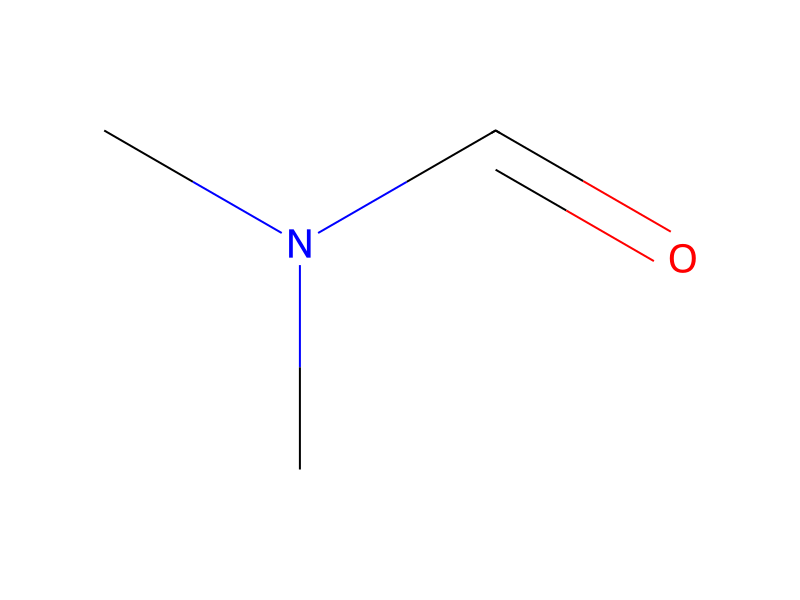
Procedure
An alternative method for preparing the chemically derivatized solid phase materials of Formula 1 involves reacting the aliphatic anion group of the aminosilane bridge on the surface of the solid phase material with homobifunctional crosslinking reagents containing two amine reactive groups (e.g. succinyl di-N-hydroxybenzotriazole, ethylene glycol bis-(succinimidyl succinate), ethylene glycol bis-(sulfosuccinimidyl succinate), disuccinimidyl tartarate, disulfosuccinimidyl tartarate, disuccinimidyl glutarate, disuccinimidyl suberate). For example, succinyl di-N-hydroxybenzotriazole may be prepared by reacting succinic acid with HBT in the presence of DMF and a water-soluble carbodiimide, such as DICD, at 2 to 5° C. for 2 to 4 hours. A white, insoluble urea by-product, (CH3)2—CH—NH—C(O)—NH—CH—(CH3)2, produced during the reaction, can be separated from the succinyl di-N-hydroxybenzotriazole by centrifuging the mixture and decanting the supernate. Then the decanted succinyl di-N-hydroxybenzotriazole in DMF can be buffered to pH 8.0 to 10.0 with an aqueous buffer and reacted with the aliphatic amino group at the solid phase surface at 20 to 30° C. for 1 to 2 hours. The solid phase material is then removed from the solution, washed with deionized water and Tween 20 and dried to produce the following chemically derivatized fluid-permeable microporous phase material within the definition of Formula 1 as illustrated in the scheme provided immediately below.
Sources & evidence
- ORD record
- ord-6dd64a051362483da2a44adecf5d249c
- Source dataset
- uspto-grants-2001_10
- Patent number
- US06306665B1
Reaction notes
Loading…