Trifluoroacetic acid → (4-(1,1-Dimethylethyl)oxyphenyl)tributyltin
Reaction equation

Br[C:2]1[CH:7]=[CH:6][C:5]([OH:8])=[CH:4][CH:3]=1.[CH3:9][C:10](=[CH2:12])[CH3:11].FC(F)(F)C(O)=O.B(F)(F)F.CCOCC.C(OC(C)(C)C)(C)(C)C.C([Li])CCC.[CH2:43]([Sn:47](Cl)([CH2:52][CH2:53][CH2:54][CH3:55])[CH2:48][CH2:49][CH2:50][CH3:51])[CH2:44][CH2:45][CH3:46]>O1CCCC1.ClCCl>[CH3:12][C:10]([O:8][C:5]1[CH:6]=[CH:7][C:2]([Sn:47]([CH2:48][CH2:49][CH2:50][CH3:51])([CH2:52][CH2:53][CH2:54][CH3:55])[CH2:43][CH2:44][CH2:45][CH3:46])=[CH:3][CH:4]=1)([CH3:11])[CH3:9]Participants
Reactant 7




Product 1

Reagents, catalysts & solvents 2
Procedure
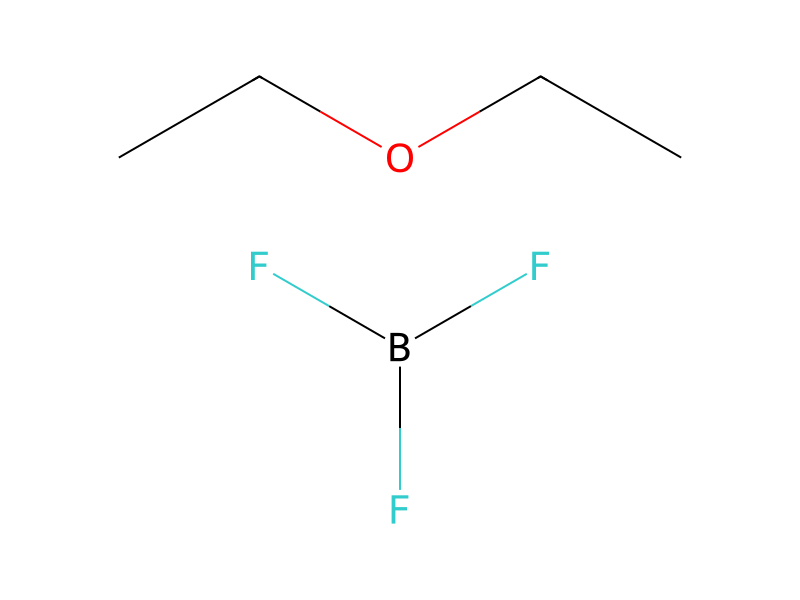
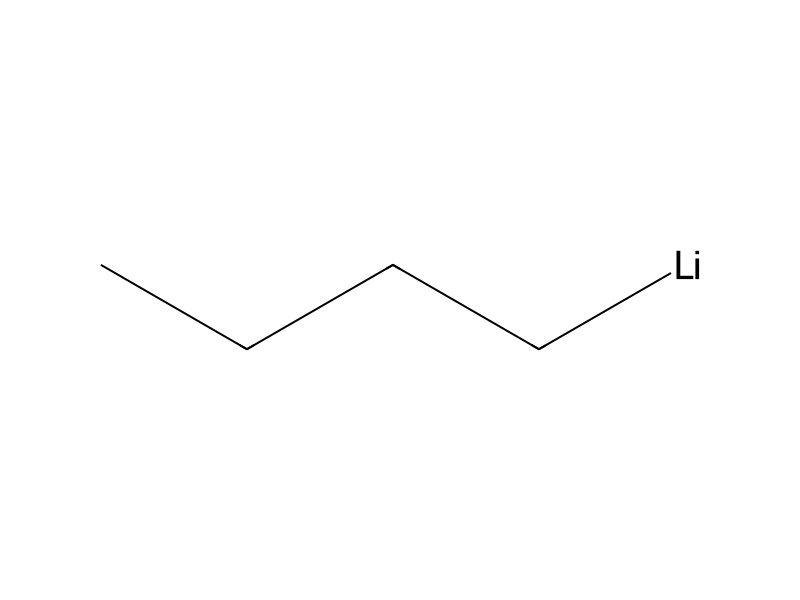
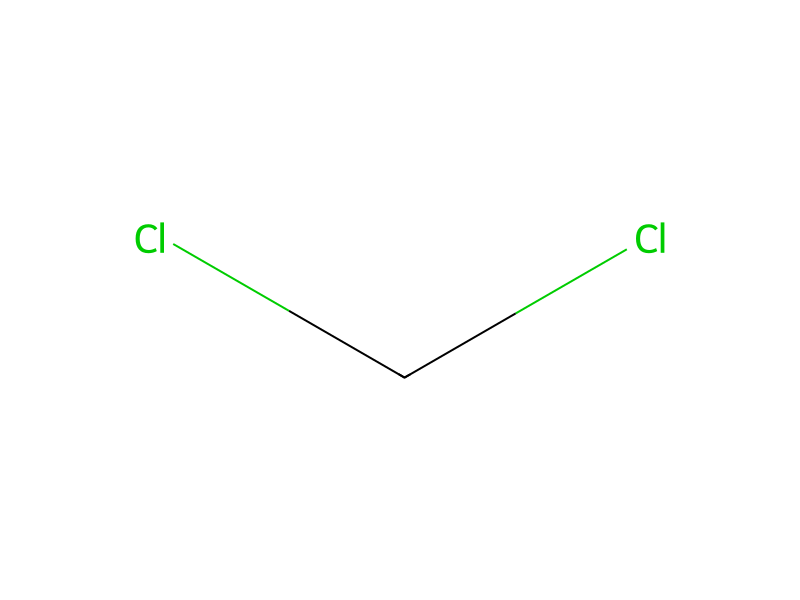
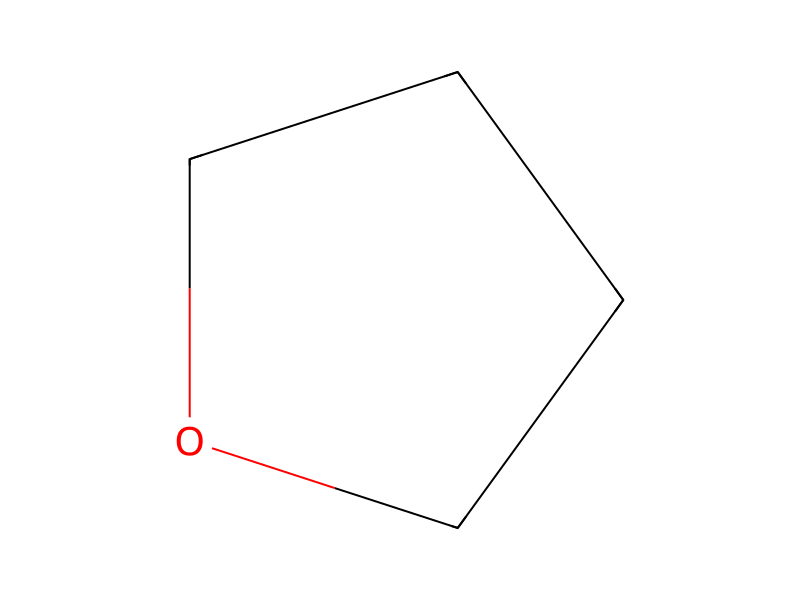
The (4-(1,1-dimethylethyl)oxyphenyl)tributyltin (27) is synthesized as set forth in Scheme 3. The commercially available 4-bromophenol is reacted with isobutylene in the presence of an acid catalyst such as, for example, trifluoroacetic acid (TFA)/triethylamine (TEA), boron trifluoride-etherate (BF3.OEt2), and the like in a suitable solvent such as, for example, dichloromethane and the like to give the t-butyl ether (26). The t-butyl ether (26) is reacted with a suitable organolithium such as, for example, n-butyl lithium and the like in tetrahydrofuran (THF) at low temperature followed by tri-n-butyltin chloride to give the (4-(1,1-dimethylethyl)oxyphenyl)tributyltin (27). The (4-(1,1-dimethylethyl)oxyphenyl)tributyltin (27) is reacted with the acid chloride (25) in the presence of a suitable catalyst such as, for example, tetrakis(triphenylphosphine)palladium(O), bis(triphenylphosphine)palladium(II)chloride, and the like with or without sodium bicarbonate in a solvent such as, for example, THF, dioxane, and the like at temperatures between about −20° C. and about reflux to give the keto-ester (28). The keto-ester (28) is deprotected by reacting with TFA in the presence of a suitable carbonium ion scavenger such as, for example, anisole, thioanisole, triethylsilane, and the like in a solvent such as, for example, dichloromethane, chloroform, and the like, and the resulting phenol is reacted with trifluoromethanesulfonic anhydride to give the triflate (29). The triflate (29) is reacted with the phenylboric acid (30), prepared by reacting the bromobenzene (31) first with n-butyl lithium or t-butyl lithium in tetrahydrofuran at low temperatures followed by trimethylborate and acid hydrolysis, in the presence of a suitable catalyst such as, for example, tetrakis(triphenylphosphine)palladium(O), bis(triphenylphosphine)palladium(II)chloride, and the like with or without sodium bicarbonate in a solvent such as, for example, THF, dioxane, and the like at temperatures between about −20° C. and about reflux to give the keto-ester (32). Alternatively, the triflate (29) can be reacted with the phenyltributyltin (33), prepared by reacting the bromobenzene (31) first with n-butyl lithium or t-butyl lithium in tetrahydrofuran at low temperatures followed by tri-n-butyltin chloride, in the presence of a suitable catalyst such as, for example, tetrakis(triphenylphosphine)palladium(O), bis(triphenylphosphine)palladium(II)chloride with or without sodium bicarbonate in a solvent such as, for example, THF, dioxane, and the like at temperatures between about −20° C. and about reflux to give the keto-ester (32). The keto-ester (32) can be hydrolyzed to the corresponding keto-acid by stirring in aqueous hydrochloric acid at a concentration between about 2 M and about 6 M and at temperatures between about 25° C. and about reflux or by reacting with an alkali metal hydroxide such as, for example, lithium hydroxide, sodium hydroxide, potassium hydroxide, and the like in a suitable solvent such as, for example, methanol, ethanol, aqueous tetrahydrofuran, and the like at temperatures between about 0° C. and about reflux, and the keto-acid can be reacted with a compound of Formula (8) with or without a suitable base such as, for example, lithium carbonate, sodium carbonate, potassium carbonate, and the like in a suitable solvent such as, for example, ethanol, methanol, isopropanol, and the like at temperatures between about 25° C. and about reflux to give the carboxylic acid (34). Alternatively, the keto-ester (32) can be hydrolyzed to the corresponding keto-acid by stirring in aqueous hydrochloric acid at a concentration between about 2 M and about 6 M and at temperatures between about 25° C. and about reflux or by reacting with an alkali meal hydroxide such as, for example, lithium hydroxide, sodium hydroxide, potassium hydroxide, and the like in a suitable solvent such as, for example, methanol, ethanol, aqueous tetrahydrofuran, and the like at temperatures between about 0° C. and about reflux, and the keto-acid can be reacted with a suitable coupling agent such as, for example, CDI, DCC, i-C4H9OCOCl, and the like followed by hydrogen sulfide to give the keto-thioacid, which in turn can be reacted with a compound of Formula (8) with or without a suitable base such as, for example, lithium carbonate, sodium carbonate, potassium carbonate and the like in a suitable solvent such as, for example, ethanol, methanol, isopropanol and the like at temperatures between about 25° C. and about reflux to give the thioacid (35).
Workup
- customThe (4-(1,1-dimethylethyl)oxyphenyl)tributyltin (27) is synthesized
Sources & evidence
- ORD record
- ord-a83b3692f103481caade218fe6daa76e
- Source dataset
- uspto-grants-2001_10
- Patent number
- US06307089B2
Reaction notes
Loading…