Sodium Chloride → Sodium Carbonate Decahydrate
Reaction equation

[C:1](=[O:4])([O-:3])[O-:2].[Na+:5].[Na+].[Na+].[Cl-].[O-:9]S([O-])(=O)=O.[Na+].[Na+]>O>[OH2:2].[OH2:9].[OH2:2].[OH2:2].[OH2:2].[OH2:2].[OH2:2].[OH2:2].[OH2:2].[OH2:2].[C:1](=[O:2])([O-:4])[O-:3].[Na+:5].[Na+:5]Participants
Reactant 3


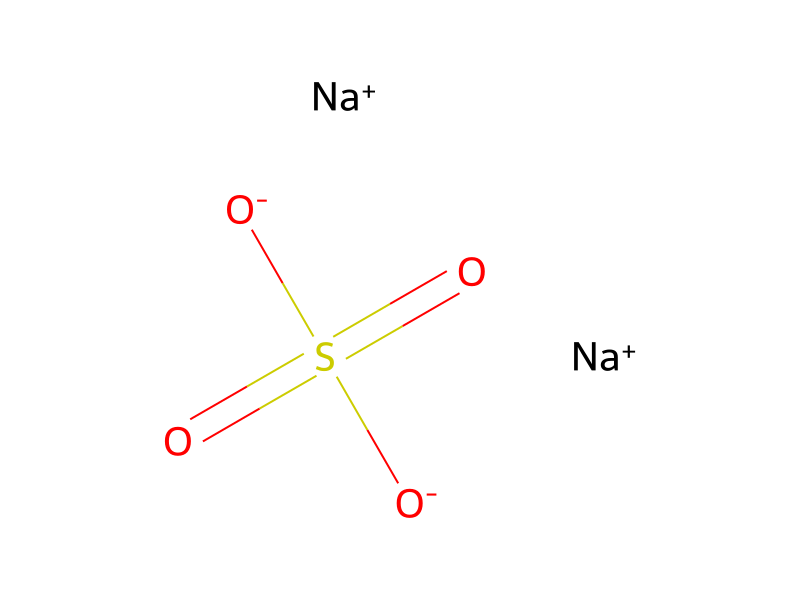
Product 1
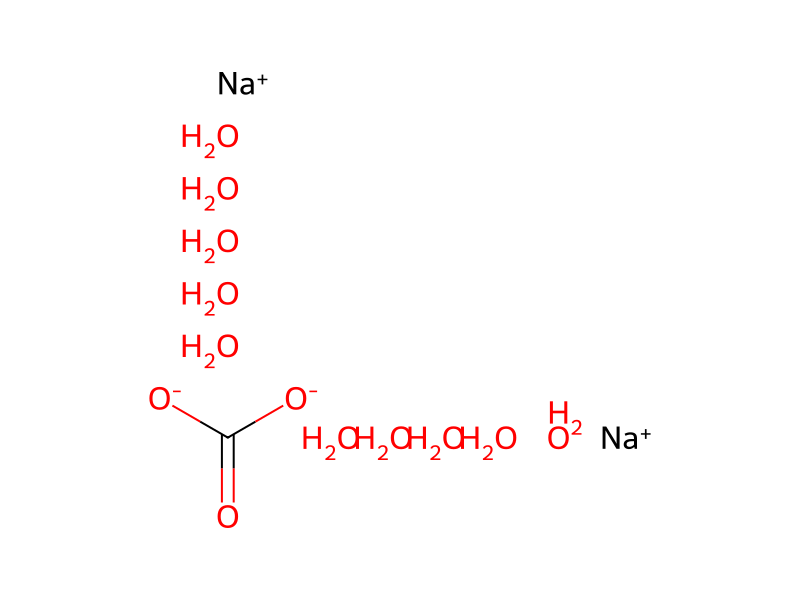
Reagents, catalysts & solvents 1

Procedure
In a fourth preferred embodiment, a method of producing sodium carbonate decahydrate includes providing a first pond area, a second pond area, and a third pond area situated at a lower elevation then the first and second pond areas. Effluent including a sodium carbonate solution in water is introduced to the first pond area to provide a pond solution comprising less than 10% NaCl and less than 3% Na2SO4. The effluent introduced into the first pond area and/or the pond solution is cooled to form crystals of sodium carbonate decahydrate which deposit at the bottom first pond area under cooling precipitation conditions, for example during a first period, such as a winter season, wherein the average daily high temperature over a thirty day period is less than 50° F. (10° C.), or preferably less than 35° F. (1.7° C.). The flow of the effluent to the first pond area is stopped. The effluent is introduced to the second pond area. A liquor is drained from the first pond area to the third pond area. The sodium carbonate decahydrate deposit is removed from the first pond area by mechanical excavation. Effluent in the second pond area repeats the same cycle as described for the first pond area in alternating winter seasons or shorter time periods. For example, during a single winter season, the effluent may be diverted from the first pond area to the second pond area, while the first pond area is cooled and drained. Then the effluent is redirected back to the first pond area, while the second pond area is cooled and drained. This cycle may be repeated until the end of the winter season or until one of the pond areas is full, whichever is sooner. In this embodiment, successive thin layers of soft sodium carbonate decahydrate are formed in each pond during a single winter season. The first pond area and the second pond area are finally drained, and the sodium carbonate decahydrate deposit is recovered from both pond areas at the end of the winter season, or from the full pond area, in a manner as previously described.
Workup
- additionis introduced to the first pond area
- customto provide a pond solution
- additionThe effluent introduced into the first pond area
- temperaturethe pond solution is cooled
Sources & evidence
- ORD record
- ord-17d9e312a6f74748b002d6027834cbd3
- Source dataset
- uspto-grants-2013_02
- Patent number
- US08372162B2
Reaction notes
Loading…