Nitric Acid → HCID 178428770, compound
Reaction equation

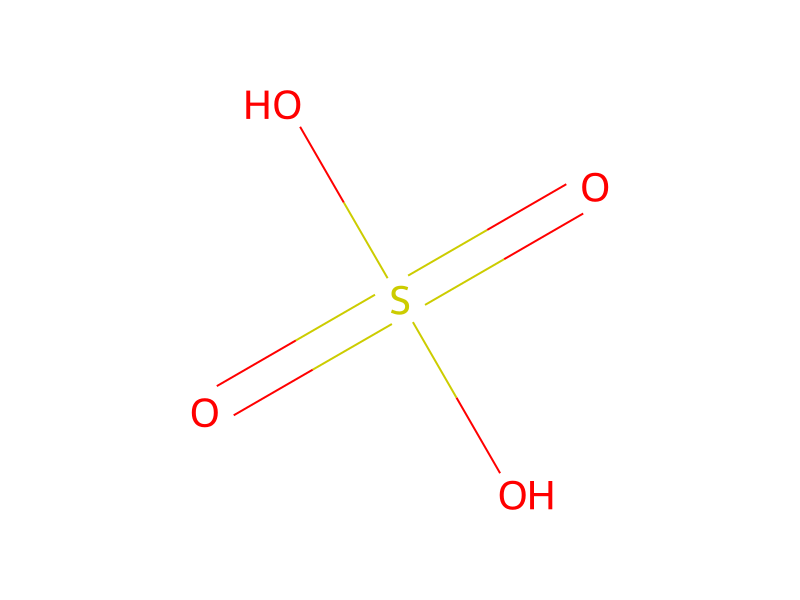
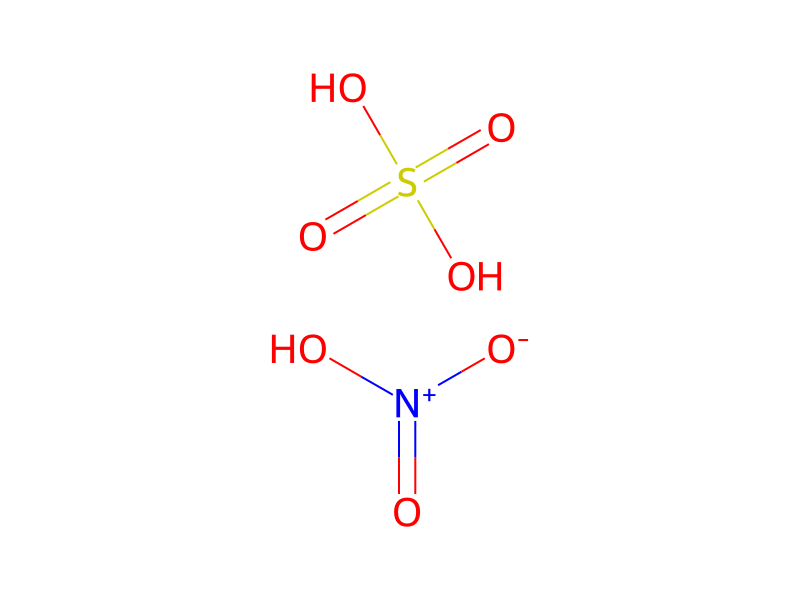
OS(O)(=O)=O.N[C:7]1[C:12]([CH3:13])=[CH:11][CH:10]=[CH:9][N:8]=1.[N+:14]([O-])([OH:16])=[O:15].[OH:18]S(O)(=O)=O.[N+]([O-])(O)=O>O>[CH3:13][C:12]1[C:7]([OH:18])=[N:8][CH:9]=[C:10]([N+:14]([O-:16])=[O:15])[CH:11]=1Participants
Reactant 4


Product 1

Reagents, catalysts & solvents 1
Conditions
- Temperature
- 12.5 °C
Procedure
A 3-necked, 2-L, round-bottomed flask equipped with a mechanical stirrer, an addition funnel and a thermometer was placed in an ice-water bath. Conc. H2SO4 (150 mL) was added to the flask. 2-Amino-3-methylpyridine (50.0 g, 0.463 mol, Lancaster, CAS 1603-40-3, mp. 29° C., prewarmed in a warm water bath to melt it) was weighed out in a 125 mL Erlenmeyer flask and was subsequently added in small portions via a prewarmed Pasteur pipet with the narrow tip broken off. The Erlenmeyer flask was kept in a warm water bath during the addition to prevent the starting material from solidifying. The temperature rose to ea. 45° C. during the addition and white smoke/fog formed within the flask. Conc. H2SO4 (100 mL) was added to the residual starting material and the mixture was added to the reaction flask. The resulting mixture was a milky-white suspension. A solution of conc. H2SO4 (35 mL) and 70% nitric acid (35 mL) was premixed with ice-water bath cooling and transferred into the addition funnel. After the internal temperature of the reaction mixture had cooled to 10-15° C. (but not below 10° C.), the premixed H2SO4/HNO3 acid mixture was added dropwise at a rate such that the internal reaction temperature rose to 20-25° C. (5-10 min addition time). After the addition was complete, the ice-water bath was replaced with a tap-water bath. The reaction temperature slowly increased to ca. 30° C. range and then cooled down to room temperature. The reaction should be monitored during this time to ensure that the temperature does not rise too high. The reaction mixture was then stirred overnight and then 70% nitric acid (35 mL) was added dropwise via the addition funnel to the dark red-brown mixture at a rate of addition such that the temperature did not exceed 35° C. At this time, the reaction flask was sitting in a water bath containing water at room temperature. Water (500 mL) was then added to the reaction flask in portions via addition funnel. The first ca. 150 mL of water was added dropwise while allowing the internal temperature to climb slowly to 50-60° C. The rate of stirring was increased in order to break up any foaming that occurred. Brown gas evolved during the addition of the initial ca. 150 mL of water. The remaining ca. 350 mL of water was added at a faster rate after gas evolution had stopped and a temperature increase was no longer observed. The reaction turned from a dark cloudy brown to a clear orange solution. Some yellow precipitate may form as the reaction cools to below 50° C. The water bath was then removed, and replaced with a heating mantle, and the addition funnel was replaced with a condenser. The reaction mixture (a light orange solution or bright yellow solution) was then heated at 115-118° C. for 1.75-2 h. Additional gas evolution occurred at ca. 115° C. during this time. The reaction mixture was then cooled to room temperature with the aid of an ice-water bath and was then cooled further to 0° C. by adding ice directly into the reaction mixture. The solid that formed was collected on a Buchner funnel and was washed with cold water followed by a minimal amount of cold ethanol followed by a minimal amount of cold ether. The solid was then dried under vacuum to afford 3-methyl-5-nitropyridin-2-ol (53.5 g, 75% yield) as a pale yellow solid: mp 228-229° C.; 1H NMR (400 MHz, DMSO-d6) δ 12.55 (s, br, 1H), 8.54 (d, J=3.0 Hz, 1H), 8.04 (d, J=2.0 Hz, 1H), 2.04 (s, 3H); 13C NMR (100 MHz, CDCl3) δ 162.2, 135.4, 130.0, 129.5, 128.1, 15.8; LRMS, (ESI) nee 152.96 [(M−H)−, calcd for C6H5N2O3, 153.03]. Anal. calcd. for C6H6N2O3: C, 46.75; H, 3.92; N, 18.17. Found: C, 46.80; H, 3.79; N, 18.14.
Workup
- customa thermometer was placed in an ice-water bath
- additionwas subsequently added in small portions via a prewarmed Pasteur pipet with the narrow tip
- additionThe Erlenmeyer flask was kept in a warm water bath during the addition
- addition45° C. during the addition and white smoke/fog
- customformed within the flask
- additionthe mixture was added to the reaction flask
- temperaturecooling
- customrose to 20-25° C.
- addition(5-10 min addition time)
- additionAfter the addition
- temperatureThe reaction temperature slowly increased to ca. 30° C. range
- temperaturecooled down to room temperature
- customThe reaction
- customdid not exceed 35° C
- customAt this time, the reaction flask was sitting in a water bath
- customto climb slowly to 50-60° C
- stirringThe rate of stirring
- temperaturewas increased in order
- temperaturea temperature increase
- customSome yellow precipitate may form as the reaction
- customcools to below 50° C
- customThe water bath was then removed
- customthe addition funnel was replaced with a condenser
- temperatureThe reaction mixture (a light orange solution or bright yellow solution) was then heated at 115-118° C. for 1.75-2 h
- customoccurred at ca. 115° C. during this time
- temperatureThe reaction mixture was then cooled to room temperature with the aid of an ice-water bath
- temperaturewas then cooled further to 0° C.
- additionby adding ice directly into the reaction mixture
- customThe solid that formed
- customwas collected on a Buchner funnel
- washwas washed with cold water
- customThe solid was then dried under vacuum
Sources & evidence
- ORD record
- ord-7aa57a79699540ce84a03773cbb6f5bd
- Source dataset
- uspto-grants-2013_02
- Patent number
- US08372847B2
Reaction notes
Loading…