Citric Acid → (2R,3S)-3-((tert-Butoxycarbonyl)amino)-2-hydroxy-4-phenylbutanoic acid
Reaction equation

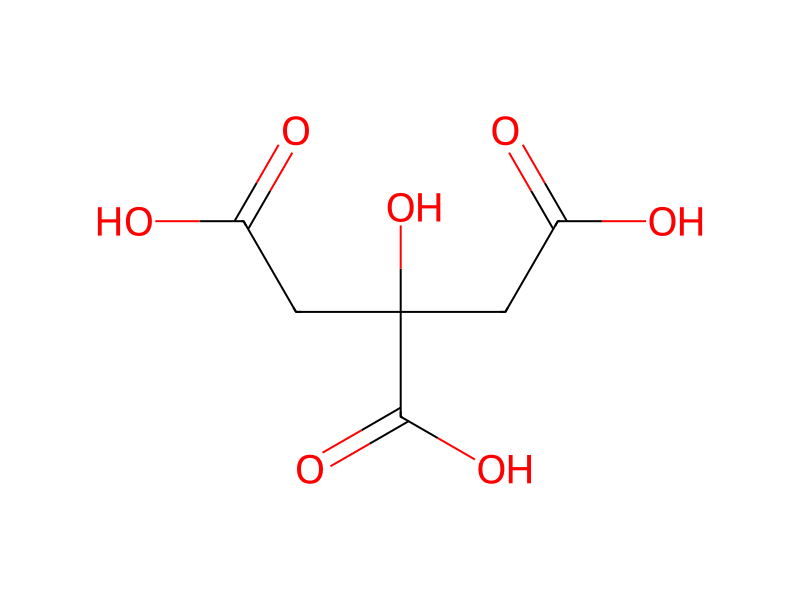
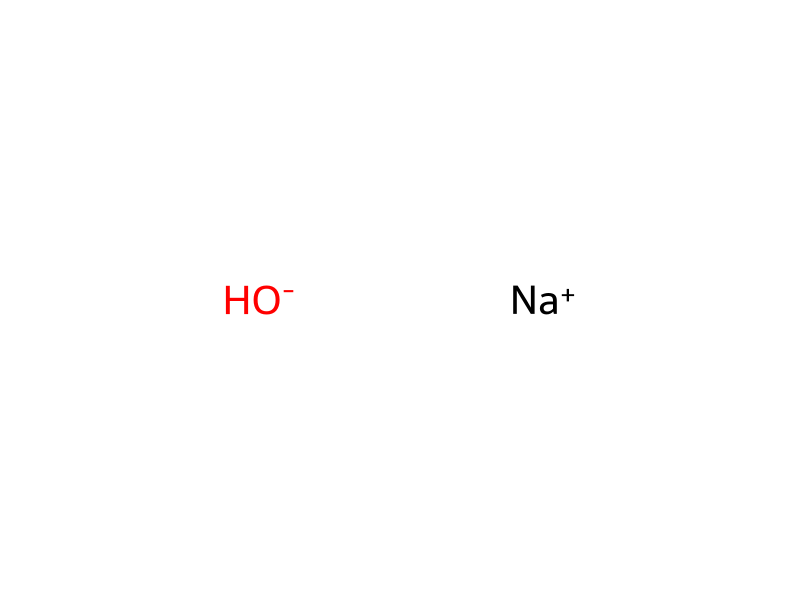
[C:1]([O:5][C:6]([NH:8][C@@H:9]([CH2:14][C:15]1[CH:20]=[CH:19][CH:18]=[CH:17][CH:16]=1)[C@H:10]([OH:13])[CH2:11]Cl)=[O:7])([CH3:4])([CH3:3])[CH3:2].CC(O)C.[OH-:25].[Na+].C(O)(=O)CC(CC(O)=O)(C(O)=O)O.[OH2:40]>>[C:1]([O:5][C:6]([NH:8][C@@H:9]([CH2:14][C:15]1[CH:20]=[CH:19][CH:18]=[CH:17][CH:16]=1)[C@@H:10]([OH:13])[C:11]([OH:40])=[O:25])=[O:7])([CH3:4])([CH3:3])[CH3:2]Participants



Conditions
- Temperature
- 4 °C
Procedure
To (2S,3S)-3-tert-butoxycarbonylamino-1-chloro-2-hydroxy-4-phenylbutane (22.9 g, (2S,3S):(2R,3S)=99.2:0.8) obtained in the same manner as in Reference Example 1 were added 2-propanol (115 ml) and water (9.6 ml). Furthermore, 4N aqueous sodium hydroxide solution (28.6 ml) was added, and the mixture was stirred at 4° C. for 3 hr. After the completion of the reaction, to the reaction mixture was added citric acid (2.45 g) dissolved in water (134 ml). The reaction mixture was once heated to 27° C. and cooled to −10° C. over 5 hr. The reaction mixture was stirred at −10° C. for 10 hr and crystals of (2S,3S)-3-tert-butoxycarbonylamino-1,2-epoxy-4-phenylbutane were collected by filtration. The wet crystals were analyzed by HPLC and confirmed to be (2S,3S):(2R,3S)=100:0. Acetonitrile (113 ml) was added to the obtained wet crystals, and then a solution of citric acid (14.7 g) in water (56 ml) was added. The mixture was stirred at 70° C. for 2 hr. The reaction mixture was cooled to room temperature and adjusted to pH=7.0 with 8N potassium hydroxide solution. To this solution were added sodium hydrogencarbonate (16.0 g) and TEMPO (0.115 g), and 12% aqueous sodium hypochrolite solution (189 g) was added dropwise at room temperature over 2 hr. After the completion of the dropwise addition, the mixture was stirred for 30 min, and potassium bromide (10.9 g) was added. The mixture was stirred for 13 hr and the 12% aqueous sodium hypochlorite solution (23.6 g) was further added. The mixture was stirred for 1 hr and sodium hydrogensulfite (3.80 g) was added to the reaction mixture. To the solution was added 8N aqueous potassium hydroxide solution (28.6 ml) and the mixture was stirred at 90° C. for 6 hr. The 8N aqueous potassium hydroxide solution (9.6 ml) was further added, and the mixture was stirred at 90° C. for 16 hr. The reaction mixture was cooled to room temperature and adjusted to pH=10 with 6N aqueous hydrochloric acid solution. A solution of di-tert-butoxycarbonate (16.7 g) in acetonitrile (20 ml) was added and the mixture was stirred at 40° C. for 2 hr. The reaction mixture was adjusted to pH=2.0 with 6N aqueous hydrochloric acid solution and the organic layer and aqueous layer were partitioned. The aqueous layer was extracted twice with ethyl acetate (100 ml, 50 ml) and the ethyl acetate layer and the organic layer partitioned earlier were combined. The organic layer was back extracted three times with 1N aqueous sodium hydroxide solution (100 ml, 50 ml, 50 ml). The aqueous layer was then adjusted to pH=1.5 with 6N aqueous hydrochloric acid solution and extracted twice with ethyl acetate (100 ml, 100 ml). This ethyl acetate solution was analyzed by HPLC, and as a result, it was confirmed that (2R,3S)-3-tert-butoxycarbonylamino-2-hydroxy-4-phenylbutyric acid (19.4 g, yield 86%) was obtained. The solvent of this solution was removed under reduced pressure. Methanol (60 ml) and water (60 ml) were added, and while stirring at 0° C., water (90 ml) was added over 30 min. The temperature was once raised to 20° C. and cooled to −3° C. over 2 hr. The mixture was stirred at −3° C. for 2 hr, and the obtained crystals were collected by filtration. The crystals were dried under reduced pressure to give the objective (2R,3S)-3-tert-butoxycarbonylamino-2-hydroxy-4-phenylbutyric acid (16.0 g, yield 71%).
Workup
- customAfter the completion of the reaction
- temperatureThe reaction mixture was once heated to 27° C.
- temperaturecooled to −10° C. over 5 hr
- stirringThe reaction mixture was stirred at −10° C. for 10 hr
- filtrationcrystals of (2S,3S)-3-tert-butoxycarbonylamino-1,2-epoxy-4-phenylbutane were collected by filtration
- additionAcetonitrile (113 ml) was added to the obtained wet crystals
- additiona solution of citric acid (14.7 g) in water (56 ml) was added
- stirringThe mixture was stirred at 70° C. for 2 hr
- temperatureThe reaction mixture was cooled to room temperature
- additionTo this solution were added sodium hydrogencarbonate (16.0 g) and TEMPO (0.115 g), and 12% aqueous sodium hypochrolite solution (189 g)
- additionwas added dropwise at room temperature over 2 hr
- additionAfter the completion of the dropwise addition
- stirringthe mixture was stirred for 30 min
- additionpotassium bromide (10.9 g) was added
- stirringThe mixture was stirred for 13 hr
- additionthe 12% aqueous sodium hypochlorite solution (23.6 g) was further added
- stirringThe mixture was stirred for 1 hr
- additionsodium hydrogensulfite (3.80 g) was added to the reaction mixture
- additionTo the solution was added 8N aqueous potassium hydroxide solution (28.6 ml)
- stirringthe mixture was stirred at 90° C. for 6 hr
- additionThe 8N aqueous potassium hydroxide solution (9.6 ml) was further added
- stirringthe mixture was stirred at 90° C. for 16 hr
- temperatureThe reaction mixture was cooled to room temperature
- additionA solution of di-tert-butoxycarbonate (16.7 g) in acetonitrile (20 ml) was added
- stirringthe mixture was stirred at 40° C. for 2 hr
- customthe organic layer and aqueous layer were partitioned
- extractionThe aqueous layer was extracted twice with ethyl acetate (100 ml, 50 ml)
- customthe ethyl acetate layer and the organic layer partitioned earlier
- extractionThe organic layer was back extracted three times with 1N aqueous sodium hydroxide solution (100 ml, 50 ml, 50 ml)
- extractionextracted twice with ethyl acetate (100 ml, 100 ml)
Sources & evidence
- ORD record
- ord-9b5159b2d19b4350844ac2d85b925208
- Source dataset
- uspto-grants-2004_10
- Patent number
- US06806384B2
Reaction notes
Loading…