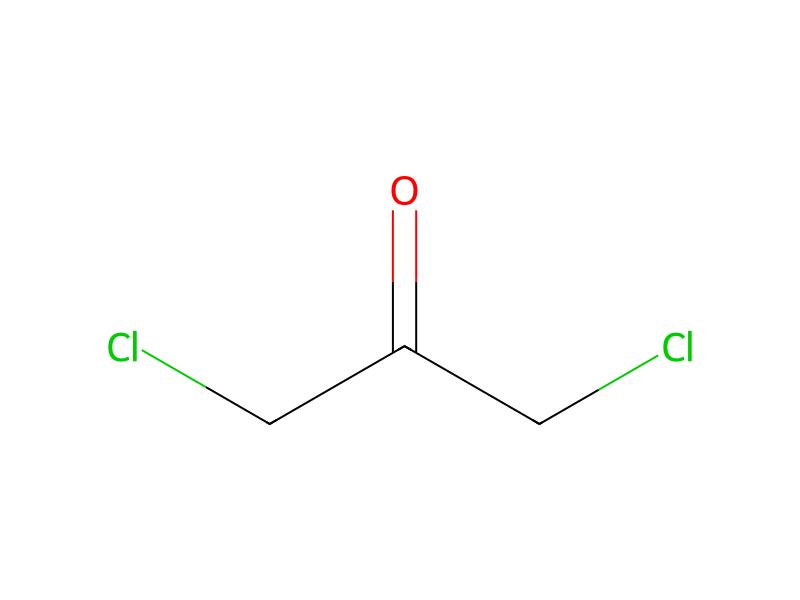
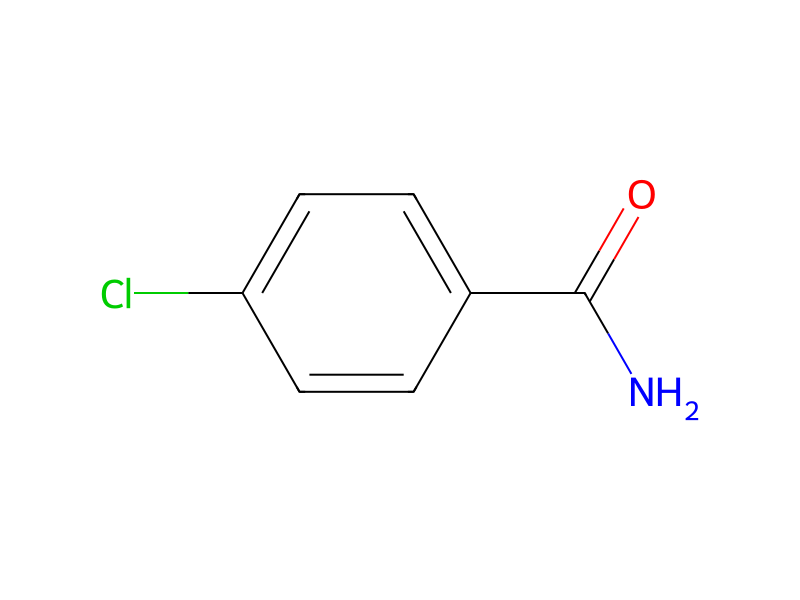
1,3-Dichloroacetone → 4-(Chloromethyl)-2-(4-chlorophenyl)-1,3-oxazole
Reaction equation

[Cl:1][C:2]1[CH:7]=[CH:6][C:5]([C:8]([NH2:10])=[O:9])=[CH:4][CH:3]=1.[Cl:11][CH2:12][C:13]([CH2:15]Cl)=O>S(=O)(=O)(O)O>[Cl:11][CH2:12][C:13]1[N:10]=[C:8]([C:5]2[CH:6]=[CH:7][C:2]([Cl:1])=[CH:3][CH:4]=2)[O:9][CH:15]=1Participants
Reactant 2
Product 1

Reagents, catalysts & solvents 1

Procedure
An amount of 123.8 g (795.5 mmol) of 4-chlorobenzenecarboxamide and 101.0 g (795.5 mmol) of 1,3-dichloroacetone were stirred at 135° C. for an hour. A melt was formed. The batch was subsequently cooled to RT with stirring, and at this temperature it was admixed cautiously with 200 ml of concentrated sulfuric acid and stirred for 30 minutes. The resulting suspension was poured into ice-water and stirred for a further 30 minutes. The precipitate formed was then isolated by suction filtration, washed with water and purified by flash chromatography on silica gel (eluent: dichloromethane). The solvent was removed on a rotary evaporator and the residue was dried under reduced pressure. This gave 95.5 g (53% of theory) of the target compound.
Workup
- customA melt was formed
- stirringstirred for 30 minutes
- stirringstirred for a further 30 minutes
- customThe precipitate formed
- customwas then isolated by suction filtration
- washwashed with water
- custompurified by flash chromatography on silica gel (eluent: dichloromethane)
- customThe solvent was removed on a rotary evaporator
- customthe residue was dried under reduced pressure
Sources & evidence
- ORD record
- ord-8168794407dc4b7a8abc2a6b14b326a7
- Source dataset
- uspto-grants-2014_06
- Patent number
- US08741834B2
Reaction notes
Loading…