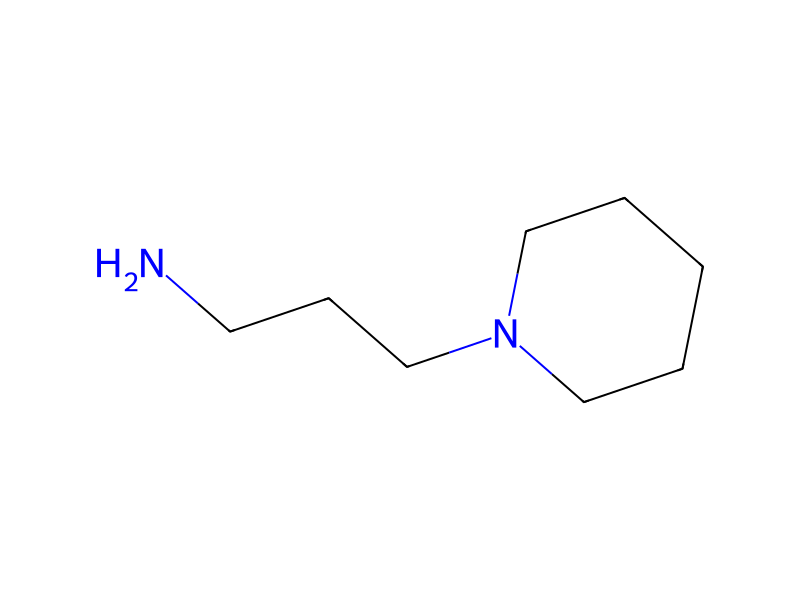
Piperidine-1-propylamine → 3-(4-chlorobenzyl)-2,4-dioxo-N-(3-(piperidin-1-yl)propyl)-1,2,3,4-tetrahydroquinazoline-7-carboxamide
Reaction equation

[Cl:1][C:2]1[CH:23]=[CH:22][C:5]([CH2:6][N:7]2[C:16](=[O:17])[C:15]3[C:10](=[CH:11][C:12]([C:18]([OH:20])=O)=[CH:13][CH:14]=3)[NH:9][C:8]2=[O:21])=[CH:4][CH:3]=1.[N:24]1([CH2:30][CH2:31][CH2:32][NH2:33])[CH2:29][CH2:28][CH2:27][CH2:26][CH2:25]1>>[N:24]1([CH2:30][CH2:31][CH2:32][NH:33][C:18]([C:12]2[CH:11]=[C:10]3[C:15]([C:16](=[O:17])[N:7]([CH2:6][C:5]4[CH:22]=[CH:23][C:2]([Cl:1])=[CH:3][CH:4]=4)[C:8](=[O:21])[NH:9]3)=[CH:14][CH:13]=2)=[O:20])[CH2:29][CH2:28][CH2:27][CH2:26][CH2:25]1Participants
3


Procedure
55 mg (45%) of the target compound was obtained in the same manner of Example 1, using 3-(4-chloro-benzyl)-2,4-dioxoquinazoline-7-carboxylic acid (90 mg, 0.272 mol) obtained in Example 1 and 3-piperidine-1-yl-propylamine (85 mL, 0.598 mmol).
Sources & evidence
- ORD record
- ord-9adff8a8f96c438eb7e25b9d113360e9
- Source dataset
- uspto-grants-2014_06
- Patent number
- US08748422B2
Reaction notes
Loading…