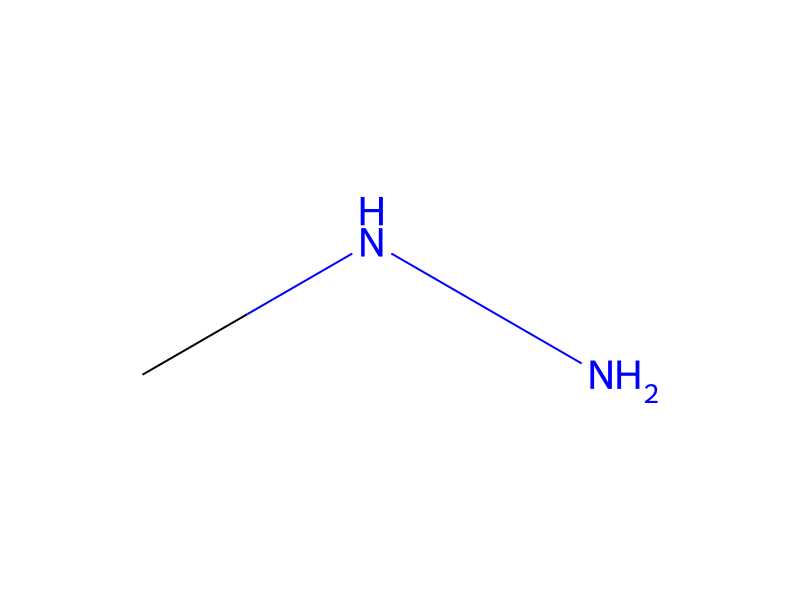
Methylhydrazine → HCID 66614304, compound
Reaction equation

[F:1][C:2]1[CH:7]=[CH:6][CH:5]=[C:4]([F:8])[C:3]=1[CH:9]=[CH:10][C:11](=O)[CH3:12].[CH3:14][NH:15][NH2:16].ClC(Cl)C(Cl)Cl>C(O)C.[O-2].[Mn+2]>[F:1][C:2]1[CH:7]=[CH:6][CH:5]=[C:4]([F:8])[C:3]=1[C:9]1[N:15]([CH3:14])[N:16]=[C:11]([CH3:12])[CH:10]=1Participants
Reactant 3


Product 1

Reagents, catalysts & solvents 2


Conditions
- Temperature
- 140 °C
Procedure
To a mixture of 4-(2,6-difluorophenyl)-3-buten-2-one (i.e. the product of Step A) (8.1 g, 44.5 mmol) in ethanol (50 mL) was added methylhydrazine (2.1 g, 49 mmol). After 24 h, the reaction mixture was concentrated under reduced pressure. To the resulting oil (10.1 g) was added 1,1,2,2-tetrachloroethane (65 mL) and manganese oxide (41.7 g, 480 mmol). The reaction mixture was heated at 140° C. for 20 minutes, and then cooled to room temperature and filtered through a pad of Celite® (diatomaceous earth) on a sintered glass frit funnel rinsing with dichloromethane (2×20 mL). The filtrate was concentrated under reduced pressure and the resulting material was purified by MPLC (10 to 50% gradient of ethyl acetate in hexanes as eluant) to provide the title compound as a light yellow solid (4.02 g).
Workup
- concentrationthe reaction mixture was concentrated under reduced pressure
- temperaturecooled to room temperature
- filtrationfiltered through a pad of Celite® (diatomaceous earth) on a sintered glass frit funnel
- washrinsing with dichloromethane (2×20 mL)
- concentrationThe filtrate was concentrated under reduced pressure
- customthe resulting material was purified by MPLC (10 to 50% gradient of ethyl acetate in hexanes as eluant)
Sources & evidence
- ORD record
- ord-de49ad2bb26e469c8000cb0cbbea7e14
- Source dataset
- uspto-grants-2014_06
- Patent number
- US08754115B2
Reaction notes
Loading…