Ethanol → Formaldehyde
Reaction equation

[CH2:1]1[O:3][CH2:2]1.[CH2:4]1O[CH:5]1[CH3:6].[CH2:8](O)C.[CH2:11]([O:13][Si](OCC)(OCC)OCC)C>O>[C:1]1([OH:3])[CH:2]=[CH:8][CH:4]=[CH:5][CH:6]=1.[CH2:11]=[O:13]Participants
Reactant 4

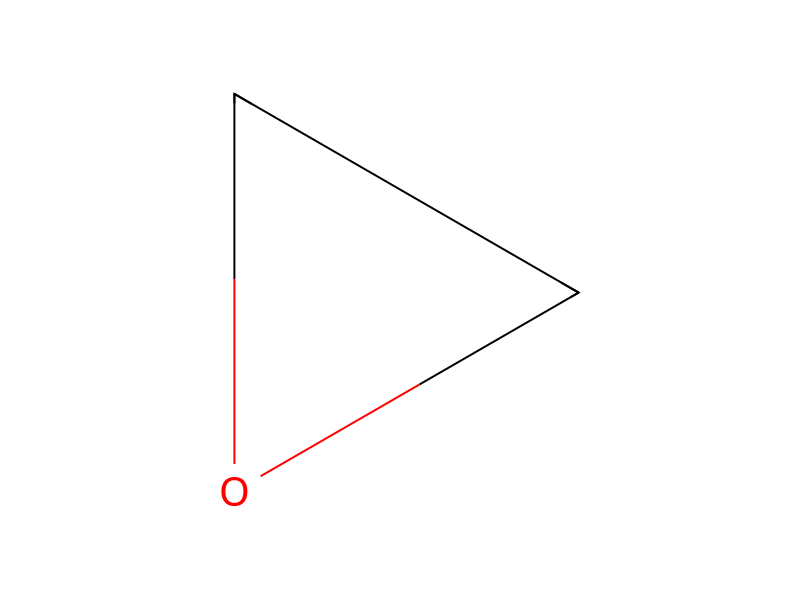


Product 2


Reagents, catalysts & solvents 1

Procedure
The nanocomposites possessed a mesoscopically ordered silica framework that was interwoven with an organic resin component. In their syntheses, Pluronic® F127 poly(ethyleneoxide)-poly(propyleneoxide)-poly(ethyleneoxide) triblock copolymer species (EO106PO70EO106), with ethyleneoxide (EO, —OCH2CH2—) and propyleneoxide (PO, —OCH(CH3)CH2—) monomer units, were used as the structure-directing agent in an ethanol solution with water as a cosolvent. Tetraethoxysilane [TEOS, Si(OCH2CH3)4] were used as a network-forming inorganic precursor, and “resol” (an oligomeric compound formed by polymerization of phenol and formaldehyde) were used as a network-forming organic precursor. The procedure involved dissolving the F127 triblock copolymer in an acidic solution of ethanol and water, the subsequent addition of TEOS and resol into the same solution, mixing for 2 hours, and then casting into Petri dishes. The ethanol was allowed to evaporate for 5-8 hours at room temperature, after which the film was thermally polymerized at 100° C. for 24 hours to promote cross-linking of the resin species. After formation of the non-porous mesostructured composite films, the films were removed from their substrates, ground into a powder, and subsequently calcined at 350° C. for 3 hours under N2 to remove the triblock copolymer species, but not the resin component within the silica framework. The powder was then carbonized at 900° C. for 2 hours under N2 and the silica was subsequently removed via immersion in 10 wt % hydrofluoric acid for 24 hours to yield a mesoporous carbon powder product. Zhao and co-workers did not report the preparation of mesoporous silica-resin films, nor did they report mechanical property measurements of any kind. The mechanical implications of incorporating an organic resin component within the silica framework were not discussed, nor optimization or correlations or with other material properties. No data or results were presented to correlate mechanical properties of the materials with the organic resin composition of the frameworks, with compositions of the mesopore surface or inorganic-organic interfaces, or extent of resin polymerization.
Sources & evidence
- ORD record
- ord-d2225ac3d8934725830589f098cd054a
- Source dataset
- uspto-grants-2014_06
- Patent number
- US08758653B2
Reaction notes
Loading…