3-Bromoaniline → N-(3-Bromophenyl)-6-nitroquinazolin-4-amine
Reaction equation

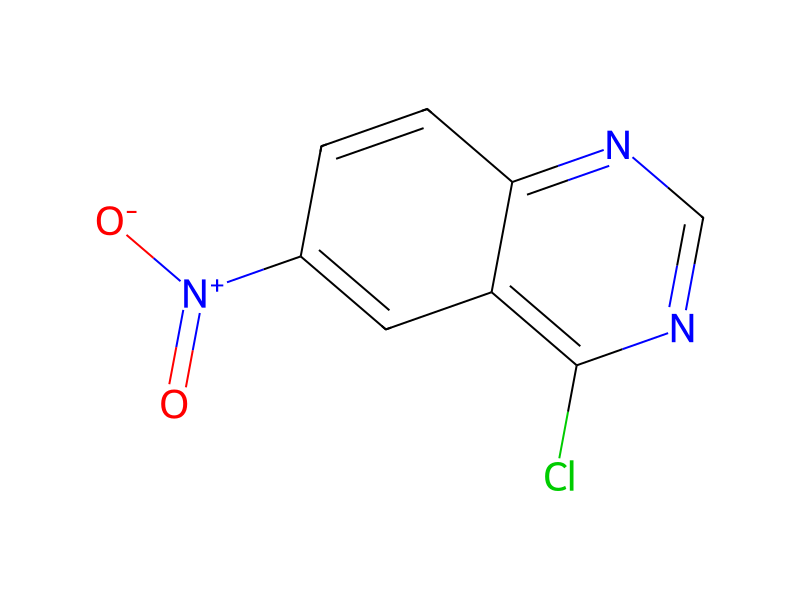
[Br:1][C:2]1[CH:3]=[C:4]([CH:6]=[CH:7][CH:8]=1)[NH2:5].Cl[C:10]1[C:19]2[C:14](=[CH:15][CH:16]=[C:17]([N+:20]([O-:22])=[O:21])[CH:18]=2)[N:13]=[CH:12][N:11]=1>>[Br:1][C:2]1[CH:3]=[C:4]([NH:5][C:10]2[C:19]3[C:14](=[CH:15][CH:16]=[C:17]([N+:20]([O-:22])=[O:21])[CH:18]=3)[N:13]=[CH:12][N:11]=2)[CH:6]=[CH:7][CH:8]=1Participants
3


Procedure
3-Bromoaniline is coupled with 4-chloro-6-nitroquinazoline, to produce 4-[(3-bromophenyl)amino]-6-nitroquinazoline, which is reduced thereafter to the corresponding 6-aminoquinazoline. The 4-[(3-bromophenyl)amino]-6-aminoquinazoline is then reacted with bistributyltin, using tetrakis(triphenylphosphine)palladium in triethylamine solution as the reaction catalyst. The stanylated quinazoline is then reacted with iodine-123 or iodine-124, in the presence of an oxidizing agent, to produce iodine-123 labeled or iodine-124 labeled 4-[(3-bromophenyl)amino]-6-aminoquinazoline, which is further reacted with acryloyl chloride as described, to yield the final iodine-123 labeled or iodine-124 labeled product.
Sources & evidence
- ORD record
- ord-13404f777b9a4cf396d111e5887e03c5
- Source dataset
- uspto-grants-2003_05
- Patent number
- US06562319B2
Reaction notes
Loading…