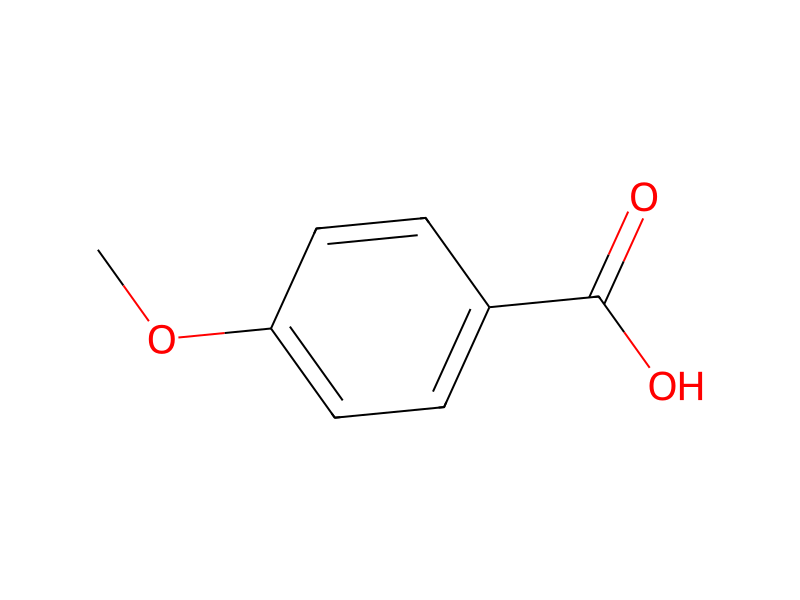
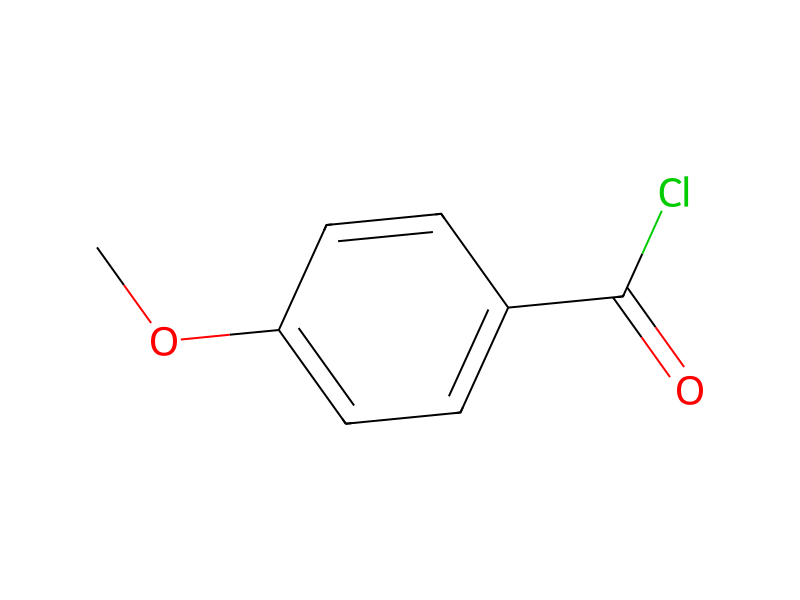
4-Methoxybenzoic Acid → p-Anisoyl chloride
Reaction equation

[CH3:1][O:2][C:3]1[CH:11]=[CH:10][C:6]([C:7](O)=[O:8])=[CH:5][CH:4]=1.S(Cl)([Cl:14])=O>>[CH3:1][O:2][C:3]1[CH:11]=[CH:10][C:6]([C:7]([Cl:14])=[O:8])=[CH:5][CH:4]=1Participants

Procedure
Thionyl chloride (10 mL) was added to 4-methoxybenzoic acid (306 mg, 2.0 mmol) and the mixture was stirred at reflux for 3 hr. Thionyl chloride was evaporated under reduced pressure and the residues was dried in vacuum to obtain 4-methoxybenzoyl chloride (320 mg). 3-Hydroxyanthranilic acid (167 mg, 1.0 mmol) and pyridine (158 mg, 2.0 mmol) were added to dichlormethane (10 mL) and the mixture was stirred at room temperature for 30 min. Then 2 (320 mg, 2.0 mmol) was added. The mixture was stirred at room temperature overnight and concentrated. The residue was purified by column chromatography (silica gel, petroleum ether:ethyl acetate=20:1 to 10:1) to yield methyl 3-hydroxy-2-(4-methoxybenzamido)benzoate as a solid (178 mg, yield 59%). LC-MS (ESI) m/z 302 [M+1]+.
Workup
- temperatureat reflux for 3 hr
- customThionyl chloride was evaporated under reduced pressure
- customthe residues was dried in vacuum
Sources & evidence
- ORD record
- ord-e2baf2326b984e2aa04c9fce7f7683e4
- Source dataset
- uspto-grants-2012_01
- Patent number
- US08088760B2
Reaction notes
Loading…