Dichloromethane → HCID 178493984, compound
Reaction equation
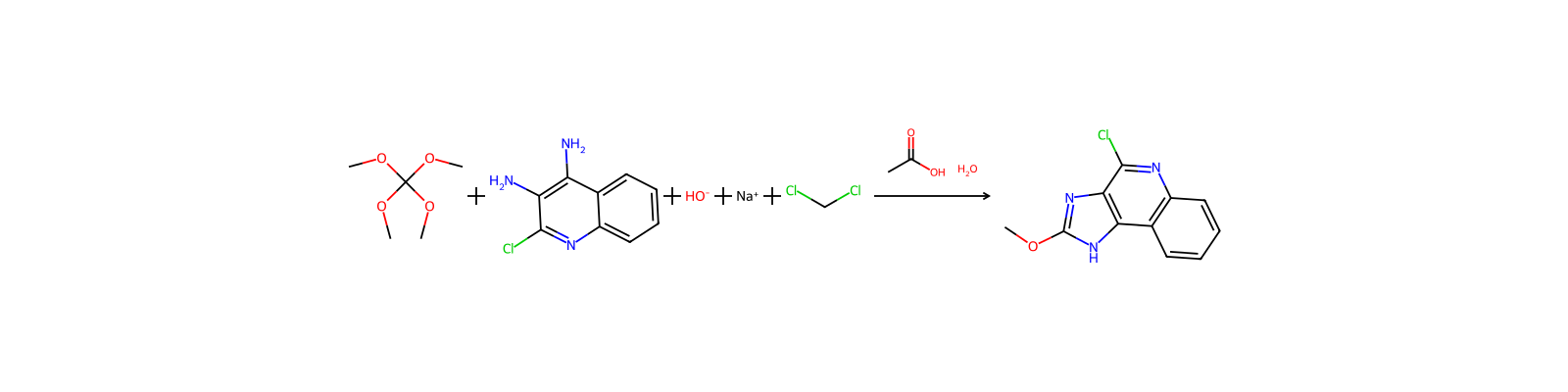
[C:1](OC)(OC)(OC)[O:2][CH3:3].[Cl:10][C:11]1[C:20]([NH2:21])=[C:19]([NH2:22])[C:18]2[C:13](=[CH:14][CH:15]=[CH:16][CH:17]=2)[N:12]=1.[OH-].[Na+].ClCCl>C(O)(=O)C.O>[Cl:10][C:11]1[C:20]2[N:21]=[C:1]([O:2][CH3:3])[NH:22][C:19]=2[C:18]2[CH:17]=[CH:16][CH:15]=[CH:14][C:13]=2[N:12]=1Participants






Procedure
Tetramethyl orthocarbonate (1.24 mL, 9.3 mmol) was added to a suspension of 2-chloroquinoline-3,4-diamine, see U.S. Pat. No. 5,756,747 (Gerster) Example 30, (1.5 g, 7.75 mmol) in acetic acid (8 mL), and the reaction was stirred overnight at room temperature. An analysis by LC/MS indicated the reaction was incomplete, and additional tetramethyl orthocarbonate (0.5 equivalent) was added. The reaction was stirred overnight at room temperature and diluted with water (100 mL). The mixture was adjusted to pH 7 with the addition of 2 N aqueous sodium hydroxide. Dichloromethane (100 mL) was added to the mixture, and a precipitate formed. The precipitate was isolated by filtration to provide 1.13 g of 4-chloro-2-methoxy-1H-imidazo[4,5-c]quinoline as a gray solid.
Workup
- customa precipitate formed
- customThe precipitate was isolated by filtration
Sources & evidence
- ORD record
- ord-feb31a5432144a5195a0c50654f84290
- Source dataset
- uspto-grants-2012_01
- Patent number
- US08088790B2
Reaction notes
Loading…