7-Hydroxycyclindole → 3-(Dimethylamino)-7-hydroxy-1,2,3,4-tetrahydrocarbazole
Reaction equation
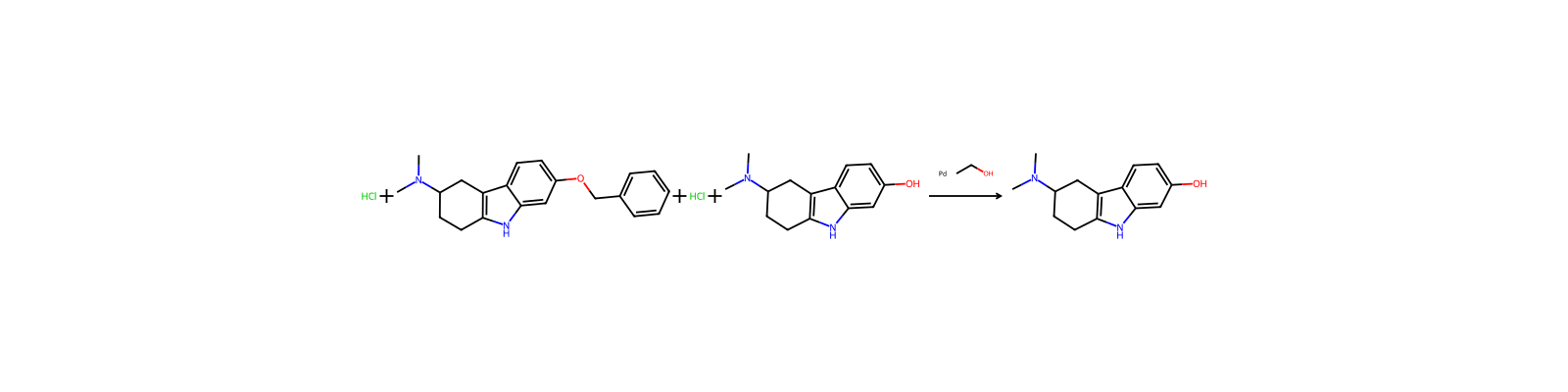
Cl.[CH3:2][N:3]([CH3:25])[CH:4]1[CH2:16][C:15]2[C:14]3[C:9](=[CH:10][C:11]([O:17]CC4C=CC=CC=4)=[CH:12][CH:13]=3)[NH:8][C:7]=2[CH2:6][CH2:5]1.Cl.CN(C)C1CC2C3C(=CC(O)=CC=3)NC=2CC1>[Pd].C(O)C>[CH3:2][N:3]([CH3:25])[CH:4]1[CH2:16][C:15]2[C:14]3[C:9](=[CH:10][C:11]([OH:17])=[CH:12][CH:13]=3)[NH:8][C:7]=2[CH2:6][CH2:5]1Participants
5
Reactant 2


Product 1

Reagents, catalysts & solvents 2


Procedure
Following a procedure similar to that described in Example 258 and using 12 g. of 3-(dimethylamino)-7-benzyloxy-1,2,3,4-tetrahydrocarbazole hydrochloride (Example 239) in 200 ml. of aqueous ethyl alcohol (1:1) and 2 g. of 10% palladium on charcoal, there was obtained 10 g. of 3-(dimethylamino)-7-hydroxy-1,2,3,4-tetrahydrocarbazole hydrochloride, m.p. 286°-288° C.
Sources & evidence
- ORD record
- ord-f8479747ccdb4d30a78013ebad6a1d78
- Source dataset
- uspto-grants-1979_10
- Patent number
- US04172834
Reaction notes
Loading…