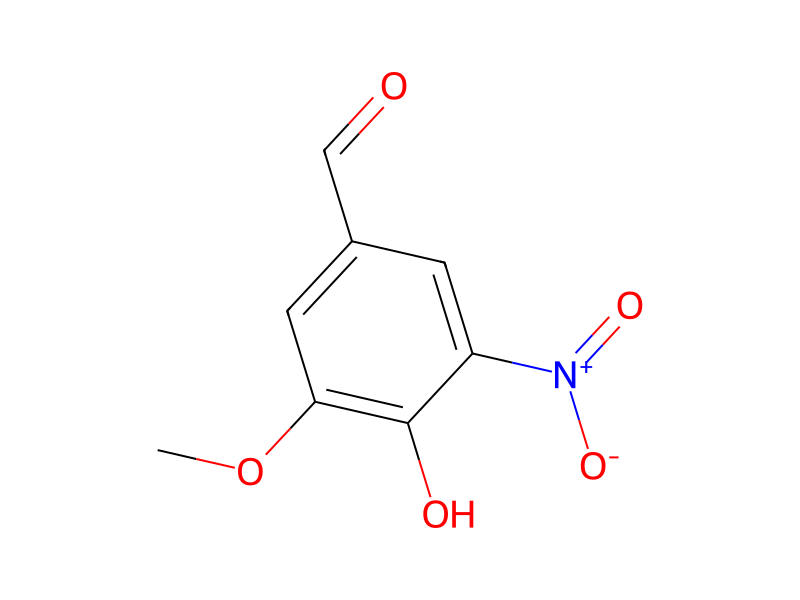
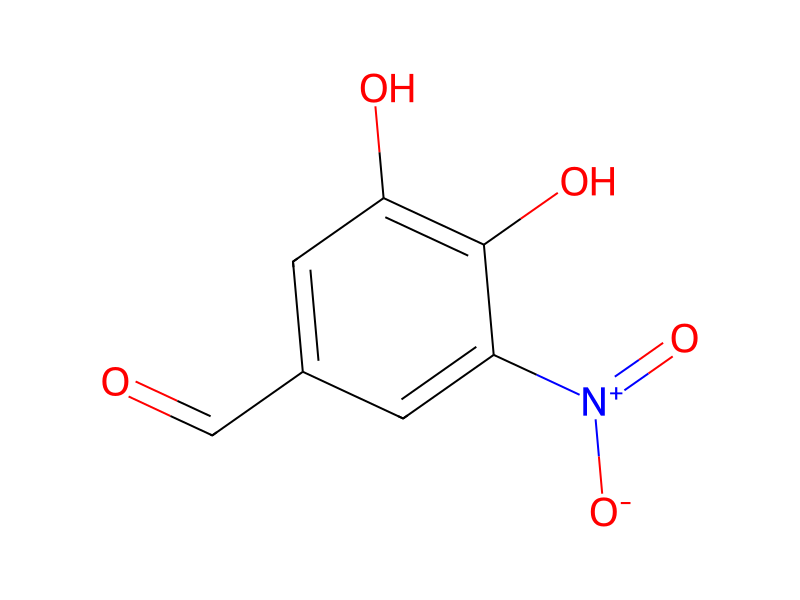
Boron tribromide → 3,4-Dihydroxy-5-nitrobenzaldehyde
Reaction equation

[N+:1]([C:4]1[C:5]([OH:14])=[C:6]([O:12]C)[CH:7]=[C:8]([CH:11]=1)[CH:9]=[O:10])([O-:3])=[O:2].B(Br)(Br)Br>ClCCl>[N+:1]([C:4]1[CH:11]=[C:8]([CH:7]=[C:6]([OH:12])[C:5]=1[OH:14])[CH:9]=[O:10])([O-:3])=[O:2]Participants
4
Reactant 2

Product 1
Reagents, catalysts & solvents 1

Conditions
- Temperature
- 0 °C
Procedure
35 g of 5-nitro vanillin (commercial) and 1200 ml of dichloromethane were mixed together under nitrogen and the mixture was cooled to 0° C. 533 ml of a molar solution of boron tribromide in dichloromethane were added and the mixture stood for 2 days at abmient temperature and then was concentrated. The residue was taken up cold (ice bath+methanol) in 300 ml of 2N hydrochloric acid and the mixture was stirred for two to three hours at this temperature, then left for 16 hours at ambient temperature. Extraction was carried out with ethyl acetate and the organic phase was washed, dried and concentrated to obtain 18 g of the expected product melting at >260° C.
Workup
- concentrationwas concentrated
- waitleft for 16 hours at ambient temperature
- extractionExtraction
- washthe organic phase was washed
- customdried
- concentrationconcentrated
Sources & evidence
- ORD record
- ord-793c9e8d4d634bfe9c149f1ad5deae11
- Source dataset
- uspto-grants-2001_11
- Patent number
- US06313305B1
Reaction notes
Loading…