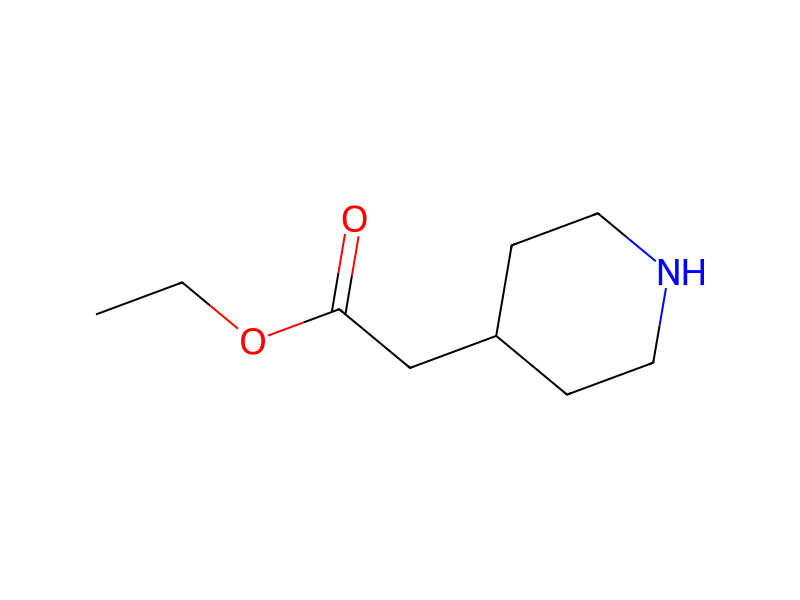
Ethyl pyridine-4-acetate → Ethyl 2-(piperidin-4-yl)acetate
Reaction equation

[CH2:1]([O:3][C:4](=[O:12])[CH2:5][C:6]1[CH:11]=[CH:10][N:9]=[CH:8][CH:7]=1)[CH3:2]>C(O)C.[Pt]=O>[CH2:1]([O:3][C:4](=[O:12])[CH2:5][CH:6]1[CH2:11][CH2:10][NH:9][CH2:8][CH2:7]1)[CH3:2]Participants

Reagents, catalysts & solvents 2


Procedure
Ethyl-4-pyridylacetate (5 g) is dissolved in ethanol (30 mL), treated with platinum oxide catalyst (30 mg) and hydrogenated on a Parr apparatus for 4 hr. The catalyst is filtered off and the ethyl-4-piperidinylacetate is isolated by removal of the solvent under vacuum. This material is then dissolved in acetonitrile (50 mL) and treated with 4-chlorobenzyl chloride (4.9 g) and sodium carbonate (10 g). The resulting mixture is heated in methanol (30 mL) and treated with a solution of lithium hydroxide (2 g) in water (10 mL). The mixture is allowed to stand overnight. Addition of 47.6 mL of 1 N HCI solution followed by concentration and extraction of the residue with chloroform provides the desired 1-(4-chlorobenzyl)-4-piperidylacetic acid. A portion of this material (1 g) is dissolved in methylene chloride and treated with 1,1′-carbonyldiimidazole (0.65 g) and allowed to stand overnight. This solution is then treated with 2-methylindoline (0.5 g). After 2 h the resulting mixture is washed 3 times with water dried and concentrated. Purification by column chromatography on silica gel provides 1.2 g of the desired 2-(1-[4-chlorobenzyl]piperidin-4-yl)-1-(2-methylindolin-1-yl)-1-ethanone (Compound 1). The dihydrochloride salt is subsequently prepared (Compound 1a).
Workup
- filtrationThe catalyst is filtered off
Sources & evidence
- ORD record
- ord-4a4a50942cc04e9fb6f86cbb93e33aa9
- Source dataset
- uspto-grants-2001_11
- Patent number
- US06316470B1
Reaction notes
Loading…