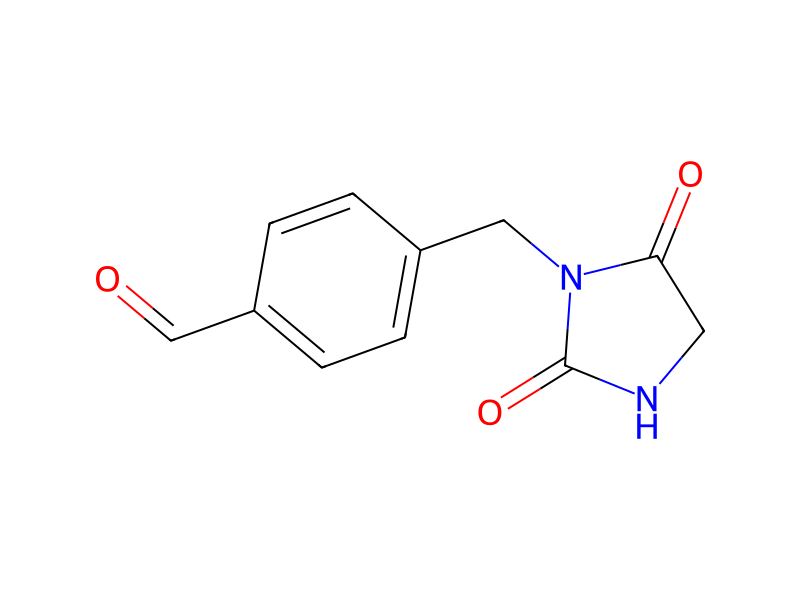
4-[(2,5-Dioxoimidazolidin-1-yl)methyl]benzonitrile → 3-(4-Formylbenzyl)hydantoin
Reaction equation

[C:1]([C:3]1[CH:16]=[CH:15][C:6]([CH2:7][N:8]2[C:12](=[O:13])[CH2:11][NH:10][C:9]2=[O:14])=[CH:5][CH:4]=1)#N.[PH2]([O-])=[O:18].[Na+]>N1C=CC=CC=1.C(O)(=O)C.O.[Ni]>[CH:1]([C:3]1[CH:16]=[CH:15][C:6]([CH2:7][N:8]2[C:12](=[O:13])[CH2:11][NH:10][C:9]2=[O:14])=[CH:5][CH:4]=1)=[O:18]Participants
5




Conditions
- Temperature
- 0 °C
Procedure
The 3-(4-cyanobenzyl)hydantoin derivative obtained in step F (about 14 mmol) was dissolved in 360 ml of a mixture of pyridine/acetic acid/water (2/1/1), cooled to 0° C. and treated with 25.1 g of sodium hypophosphite (monohydrate) and 4.17 g of moist Raney nickel. After stirring at 60° C. for 6 h, the solvents were removed in vacuo and the residue was taken up in ethyl acetate. The solvent was washed with 10% strength citric acid solution, saturated sodium bicarbonate solution and saturated sodium chloride solution and dried over magnesium sulfate. After filtration and concentration, the 3-(4-formylbenzyl)hydantoin derivative obtained was employed in the next step without further purification.
Workup
- customthe solvents were removed in vacuo
- washThe solvent was washed with 10% strength citric acid solution, saturated sodium bicarbonate solution and saturated sodium chloride solution
- dry with materialdried over magnesium sulfate
- filtrationAfter filtration and concentration
Sources & evidence
- ORD record
- ord-5e927dba59bc42b0832fb1ce884b1a2d
- Source dataset
- uspto-grants-2003_12
- Patent number
- US06667334B1
Reaction notes
Loading…