Water → Calcium di(L-lysinate)
Reaction equation

[O-2].[Ca+2:2].[NH2:3][C@H:4]([C:10]([OH:12])=[O:11])[CH2:5][CH2:6][CH2:7][CH2:8][NH2:9].O>CCCCCC>[NH2:3][C@H:4]([C:10]([O-:12])=[O:11])[CH2:5][CH2:6][CH2:7][CH2:8][NH2:9].[Ca+2:2].[NH2:3][C@H:4]([C:10]([O-:12])=[O:11])[CH2:5][CH2:6][CH2:7][CH2:8][NH2:9]Participants
5
Reactant 3

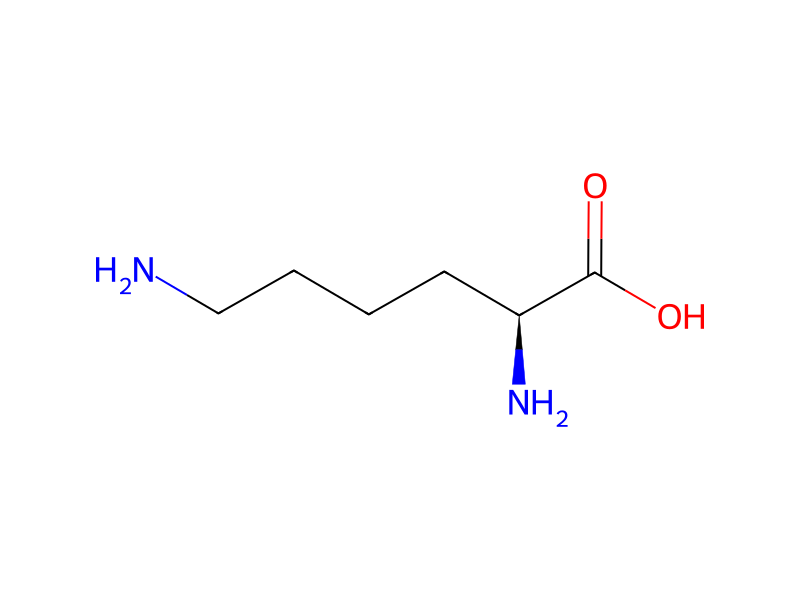

Product 1

Reagents, catalysts & solvents 1

Procedure
5.6 grams (0.1 Mole) of calcium oxide and 29.2 grams (0.2 Mole) of lysine were placed into a beaker provided with a reflux condenser and a Dean Stark water trap. 100 ml hexane was added and the mixture was stirred and boiled at atmospheric pressure for 5 hours. The reaction mixture was cooled, and was thereafter filtered yielding 32.8 grams of calcium lysinate having the physical characteristic of a fine white powder. In the course of reaction about 3.6-3.8 ml water was removed from the reaction media and acquired in the Dean Stark apparatus.
Workup
- customprovided with a reflux condenser
- temperatureThe reaction mixture was cooled
- filtrationwas thereafter filtered
Sources & evidence
- ORD record
- ord-3754024031f541969f483a6e6abb888c
- Source dataset
- uspto-grants-2003_12
- Patent number
- US06670494B1
Reaction notes
Loading…