Triethyl phosphite → HCID 54111407, compound
Reaction equation

Cl[CH2:2][P:3](=[O:6])([CH3:5])[CH3:4].[CH2:7]([O:9][P:10]([O:14]CC)[O:11][CH2:12][CH3:13])[CH3:8]>>[CH2:7]([O:9][P:10]([CH2:2][P:3]([CH3:5])([CH3:4])=[O:6])(=[O:14])[O:11][CH2:12][CH3:13])[CH3:8]Participants
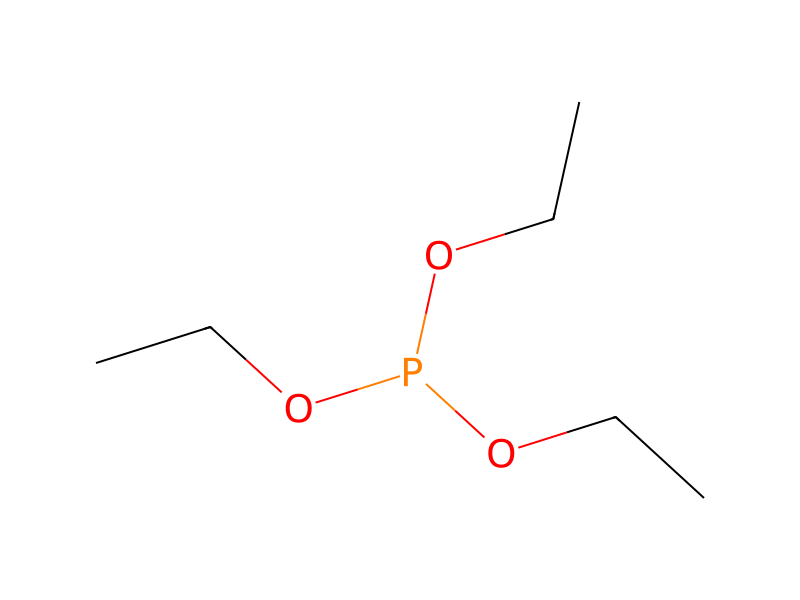


Procedure
252 g of chloromethyl-dimethylphosphine oxide are heated to 140° to 150° C. under an atmosphere of nitrogen and 480 g of triethylphosphite are added dropwise in the course of 4 hours. Stirring is continued for a further 1.5 hours at the temperature indicated, 98 g of ethyl chloride (76% of theoretical) being collected in a cold trap connected downstream of the apparatus. The mixture is then incipiently distilled at 0.6 mm Hg until the internal temperature reaches 148° C., with distillate passing over at a temperature of 135° C. This gives 309 g of the ester, having a solidification point of 59°-60° C. (yield: 68 percent of theoretical). The product can be employed for further reactions in the form of the crude product; further purification can be effected by distillation (boiling point at 0.4 mm Hg: 140° C.).
Workup
- custom98 g of ethyl chloride (76% of theoretical) being collected in a cold trap
- distillationThe mixture is then incipiently distilled at 0.6 mm Hg until the internal temperature
- customreaches 148° C., with distillate passing over at a temperature of 135° C
- customa solidification point of 59°-60° C. (yield: 68 percent of theoretical)
- customfurther purification
- distillationcan be effected by distillation (boiling point at 0.4 mm Hg: 140° C.)
Sources & evidence
- ORD record
- ord-783b57b3f4c94037961e0e969258715b
- Source dataset
- uspto-grants-1983_08
- Patent number
- US04401473
Reaction notes
Loading…