Cyanoacetamide → 3-(3-Methoxyphenyl)-3-oxopropanenitrile
Reaction equation

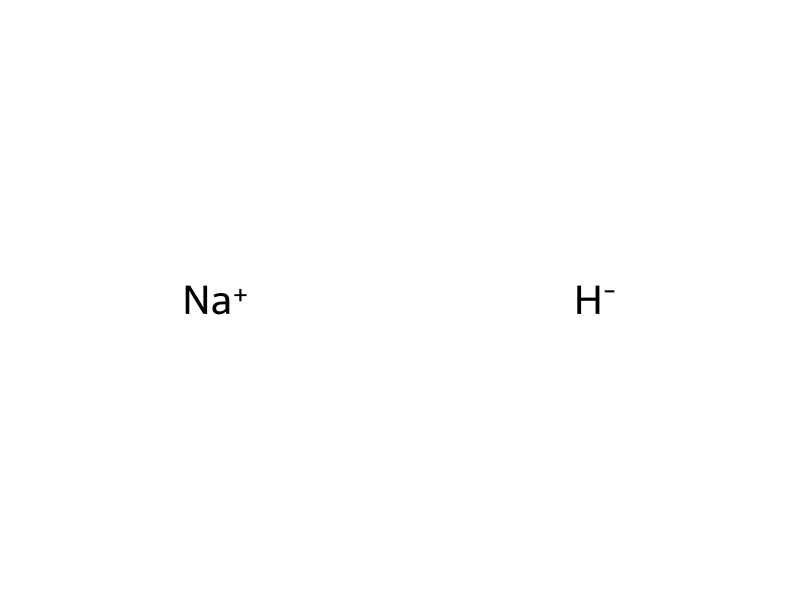
[C:1]([CH2:3][C:4](N)=[O:5])#[N:2].[H-].[Na+].C(O[CH:12]([O:16][CH2:17][CH3:18])N(C)C)C.C(OC(OCC(C)(C)C)N(C)C)C(C)(C)C.[C:35]([CH:37]([C:41]1CCCC(=O)[CH:42]=1)C(N)=O)#N>>[CH3:12][O:16][C:17]1[CH:18]=[C:42]([C:4]([CH2:3][C:1]#[N:2])=[O:5])[CH:41]=[CH:37][CH:35]=1Participants



Procedure
The novel intermediates of the present invention originate from a novel process which utilizes dihydro=resorcinol as the starting material. That substance thus is allowed to react with a chlorinating reagent such as phosphorus trichloride to afford 3-chloro-2-cyclohexen-1-one. Reaction with cyanoacetamide and sodium hydride results in α-cyano-3-oxo-1-cyclohexen-1-acetamide, which is contacted with a dialkylformamide acetal, for example dimethylformamide diethyl acetal or dimethylformamide dineopentyl acetal, to produce 2,3,5,6,7,8-hexahydro-3,8-dioxo-4-isoquinolinecarboni=trile. Elimination of the cyano group is effected by heating with hydrobromic acid, thus affording 2,3,5,6,7,8-hexahydro-3,8-isoquinolinedione. Heating with an alkyl, trialkylsilyl or cycloalkyl halide produces the corresponding 6-alkoxy, 6-trialkylsilyloxy and 6-cycloalkoxy 7-aza-1-tetralones together with the N-alkylated or N-cycloalkylated derivatives. Typically, 2,3,5,6,7,8-hexahydro-3,8-isoquinolinedione is heated in benzene at the reflux temperature with methyl iodide and silver carbonate to yield 7-aza-6-methoxy-1-tetra=lone together with 2-methyl-2,3,5,6,7,8-hexahydro-3,8-isoquinolinedione. The reaction of the keto group of the latter tetralone with vinyl magnesium chloride results in 7-aza-6-methoxy-1-vinyl-1-tetralol, which is contacted with a 2-(lower alkyl)cyclopentane-1,3-dione, such as 2-methylcyclopentane-1,3-dione, in the presence of a basic catalyst such as triethylamine to afford 5,6,7,8-tetrahydro-3-methoxy-8-[(2-methyl-1,3-dioxocylopent-2-yl)ethylidene]isoquinoline. Alternatively, the tetralol is converted to the iso-thiouronium salt, which is reacted with the dione to afford the latter product. Cyclization of the latter diketone, suitably in the presence of p-toluenesulfonic acid, results in dl-2-aza-3-methoxyestra-1,3,5(10), 8,14-pentaen-17-one. Catalytic hydrogenation, using a palladium-on-calcium carbonate catalyst effects saturation of the 14-double bond, thus producing dl-2-aza-3-methoxyestra-1,3,5(10),8-tetraen-17-one, while chemical reduction, for example with sodium borohydride, converts the 17-keto group, thus yielding dl-2-aza-3-methoxyestra-1,3,5(10),8,14-pentaen-17β-ol. The 14-double bond of the latter substance is catalytically reduced, using a palladium-on-calcium carbonate catalyst, to yield dl-2-aza-3-methoxy=estra-1,3,5(10),8-tetraen-17β-ol, which is allowed to react with sodium in liquid ammonia to afford dl-2 -aza-3-methoxyestra-1,3,5(10)-trien-17β-ol.
Sources & evidence
- ORD record
- ord-ac659adb738e4669aa578011c02ed14b
- Source dataset
- uspto-grants-1977_02
- Patent number
- US04007194
Reaction notes
Loading…