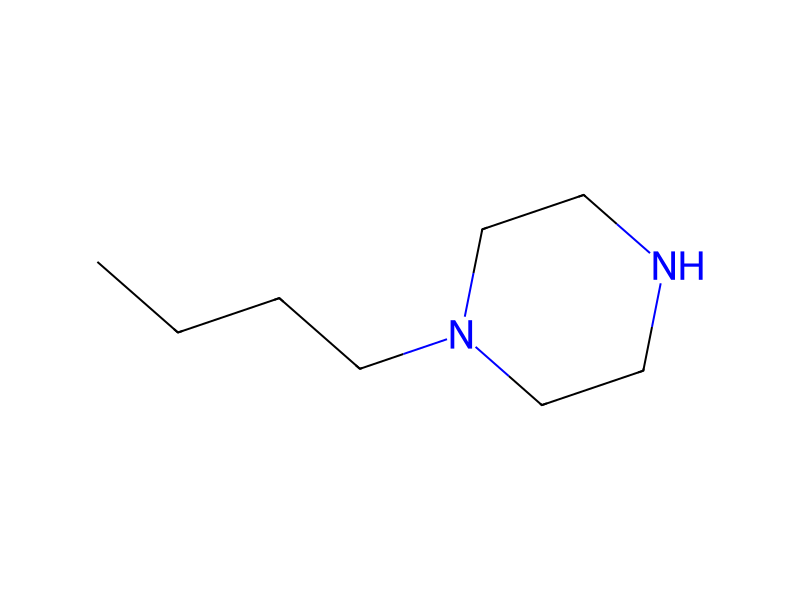
1-Butylpiperazine → HCID 21430487, compound
Reaction equation

[Cl:1][C:2]1[C:7]([C:8]([OH:10])=[O:9])=[CH:6][C:5]([S:11](=[O:14])(=[O:13])[NH2:12])=[C:4](F)[CH:3]=1.[CH2:16]([N:20]1[CH2:25][CH2:24][NH:23][CH2:22][CH2:21]1)[CH2:17][CH2:18][CH3:19]>O>[CH2:16]([N:20]1[CH2:25][CH2:24][N:23]([C:4]2[CH:3]=[C:2]([Cl:1])[C:7]([C:8]([OH:10])=[O:9])=[CH:6][C:5]=2[S:11](=[O:14])(=[O:13])[NH2:12])[CH2:22][CH2:21]1)[CH2:17][CH2:18][CH3:19]Participants
4
Reactant 2

Product 1

Reagents, catalysts & solvents 1

Procedure
126 Grams of 6-chloro-4-fluoro-3-sulfamoylbenzoic acid (0.5 mole) were stirred with 0.2 l of N-butylpiperazine for 2 hours at 110° C. Subsequently the reaction solution was poured into 2 l of water, a small amount of amorphous precipitate formed was separated, and the filtrate was adjusted to a pH of 7.5 with 2N HCl. After having stood overnight at room temperature, the crystalline precipitate was suction-filtered and was recrystallized from a mixture of ethanol and water.
Workup
- customa small amount of amorphous precipitate formed
- customwas separated
- filtrationthe crystalline precipitate was suction-filtered
- customwas recrystallized from a mixture of ethanol and water
Sources & evidence
- ORD record
- ord-e3f389eca53b4245b0739a11d99ecfad
- Source dataset
- uspto-grants-1977_06
- Patent number
- US04029787
Reaction notes
Loading…