Potassium Nitrate → 5-Iodo-6-nitro-7-chloro-1,4-dihydro-2,3-quinoxalinedione
Reaction equation

[I:1][C:2]1[CH:11]=[C:10]([Cl:12])[CH:9]=[C:8]2[C:3]=1[NH:4][C:5](=[O:14])[C:6](=[O:13])[NH:7]2.[N+:15]([O-])([O-:17])=[O:16].[K+]>OS(O)(=O)=O.[OH-].[K+]>[I:1][C:2]1[C:11]([N+:15]([O-:17])=[O:16])=[C:10]([Cl:12])[CH:9]=[C:8]2[C:3]=1[NH:4][C:5](=[O:14])[C:6](=[O:13])[NH:7]2Participants
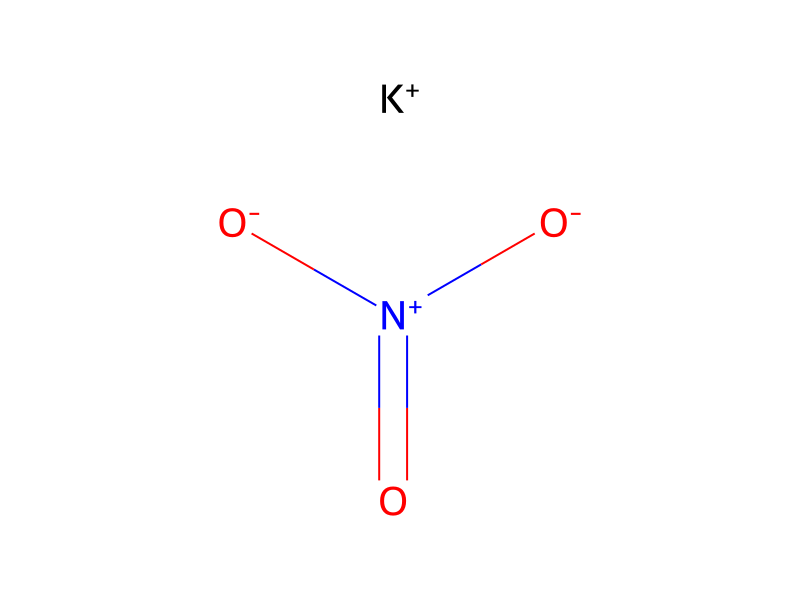




Conditions
- Temperature
- 0 °C
Procedure
The method of Cheeseman, G. W. H. (J. Chem. Soc. 1170 (1962)) was adapted. 5-Iodo-7-chloro-1,4-dihydro-2,3-quinoxalinedione (96 mg, 0.33 mMol) was dissolved in concentrated H2SO4 (1.0 mL) at 0° C. for 30 min and then KNO3 (36 mg, 0.36 mMol, Baker) was added into this solution. The mixture was stirred at 0° C. for 0.5 h and then at room temperature for 30 h. It was poured into ice water (5 g). A precipitate came out and was collected by filtration giving 101 mg of crude title compound. The sample was dissolved in 1N KOH (5 mL) and then red precipitate was removed by filtration. The filtrate was acidified to pH=2 with 4N HCl to give a brown precipitate which was collected by filtration and then dried in air at 50° C. for 4 h. The title compound (75 mg, 67%) was obtained as a brown powder. Crystallization from DMSO/H2O afforded pure compound (34 mg) as brown microcrystals, mp: 388°-90° C. IR (KBr, cm-1): 3462, 3200, 3050, 1712, 1587, 1537. NMR (1H, DMSO-d6): δ7.289 (s, 1H), 10.846 (s, 1H), 12.225 (s, 1H). HRMS: calcd for C8H3N3O4ClI (M+) m/z: 366.8855, found pending. Potency relative to DCK: partially active.
Workup
- waitat room temperature for 30 h
- filtrationwas collected by filtration
- customgiving 101 mg of crude title compound
- customred precipitate was removed by filtration
- customto give a brown precipitate which
- filtrationwas collected by filtration
- customdried in air at 50° C. for 4 h
Sources & evidence
- ORD record
- ord-99276e2f8fb14fa19b3309060943e745
- Source dataset
- uspto-grants-1996_05
- Patent number
- US05514680
Reaction notes
Loading…