HuagongsheHuagongshe Chemistry Print Report · For research reference only
HRID 441Generated: October 27, 2026
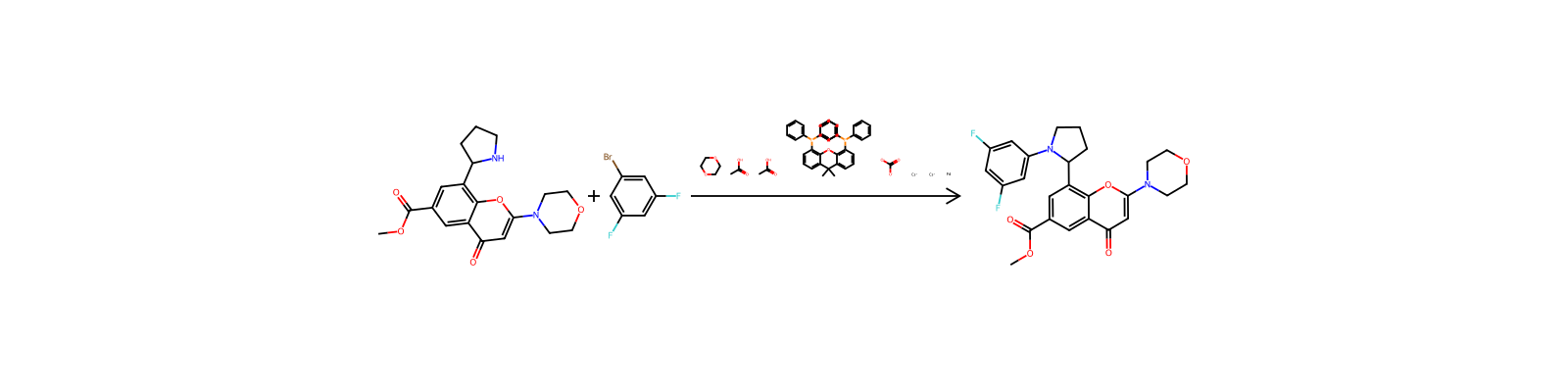
1-Bromo-3,5-difluorobenzene → methyl 8-(1-(3,5-difluorophenyl)pyrrolidin-2-yl)-2-morpholino-4-oxo-4H-chromene-6-carboxylate
https://huagongshe.com/reaction/441
Participants
| Role | Name | HCID | Charge |
|---|
| Reactant | 1-Bromo-3,5-difluorobenzene | HCID 136313 | — |
| Reactant | methyl 2-morpholino-4-oxo-8-(pyrrolidin-2-yl)-4H-chromene-6-carboxylate | HCID 86672405 | — |
| Reagent | Cesium carbonate | HCID 10796 | — |
| Catalyst | 1,1'-(9,9-Dimethyl-9H-xanthene-4,5-diyl)bis(1,1-diphenylphosphine) | HCID 636044 | — |
| Catalyst | Palladium (II) acetate | HCID 4144353 | — |
| Solvent | 1,4-Dioxane | HCID 31275 | — |
| Product | methyl 8-(1-(3,5-difluorophenyl)pyrrolidin-2-yl)-2-morpholino-4-oxo-4H-chromene-6-carboxylate | HCID 86672406 | 52.18% |
Reaction Steps
diacetoxypalladium (6.26 mg, 0.03 mmol) was added to a stirred mixture of methyl 2-morpholino-4-oxo-8-(pyrrolidin-2-yl)-4H-chromene-6-carboxylate (200 mg, 0.56 mmol), 1-bromo-3,5-difluorobenzene (0.080 ml, 0.70 mmol) and cesium carbonate (273 mg, 0.84 mmol) dissolved in 1,4-dioxane (8 ml). The resulting suspension was degased with argon and then stirred at 100 °C (15:00) for 18 hours. The reaction mixture was allowed to cool to room temperature, filtered and concentrated. The crude product was adsorbed on silica gel and purified by flash chromatography on silica gel eluting with 0 to 6% methanol in ethyl acetate. The solvent was evaporated to dryness to afford methyl 8-(1-(3,5-difluorophenyl)pyrrolidin-2-yl)-2-morpholino-4-oxo-4H-chromene-6-carboxylate (137 mg, 52.2 %) as a clear yellow foam. LCMS and NMR are OK.
Provenance & Evidence
| Source dataset | 750 AstraZeneca ELN dataset |
|---|
| ORD ID | ord-e061647f5f0c433f84efb82229734131 |
|---|
| Source note | 750 AstraZeneca ELN dataset |
|---|