HuagongsheHuagongshe Chemistry Print Report · For research reference only
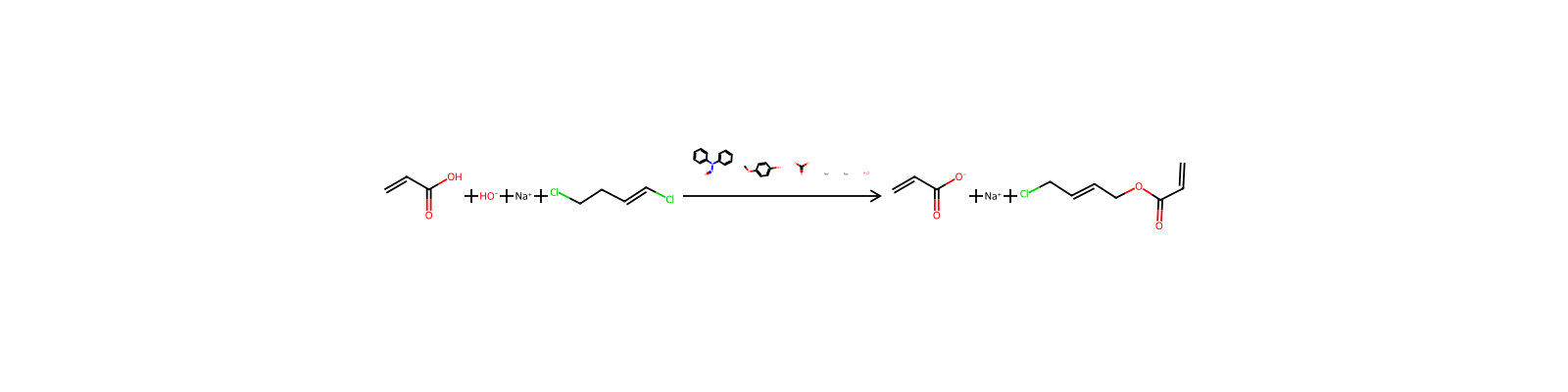
Acrylic Acid → 4-Chloro-2-butenyl acrylate
Participants
| Role | Name | HCID | Charge |
|---|---|---|---|
| Reactant | Acrylic Acid | HCID 6581 | — |
| Reactant | Sodium Hydroxide | HCID 14798 | — |
| Reactant | CID 35801 | HCID 35801 | — |
| Catalyst | N-Nitrosodiphenylamine | HCID 6838 | — |
| Catalyst | 4-Methoxyphenol | HCID 9015 | — |
| Catalyst | Sodium Carbonate | HCID 10340 | — |
| Solvent | Water | HCID 962 | — |
| Product | Sodium acrylate | HCID 4068533 | — |
| Product | 4-Chloro-2-butenyl acrylate | HCID 54241943 | 118.7% |
Reaction Steps
An aqueous solution of sodium acrylate is prepared from 216.2 g of acrylic acid (100%=3 mol), 262.8 g of NaOH (50%) and 497 g of water. 3.7 g of N-nitrosodiphenylamine and 3.7 g of 4-methoxyphenol are added to stabilize the solution. 12 g of the quaternary ammonium salt used in Example 1 are also added. 1,125 g (9 mol) of 1,4-dichlorobutene are run in at 90° C. 15.9 g of Na2CO3 are added after 1 hour and the mixture is left to react for a further 2 hours at 90° C. After phase separation, the organic layer is distilled under vacuum. 286.0 g (1.78 mol) of 4-chloro-2-butenyl acrylate (59.4% of the theoretical yield) are obtained. 641 g (5.13 mol) of dichlorobutene are recovered.
Provenance & Evidence
| DOI | 10.6084/m9.figshare.5104873.v1 |
|---|---|
| Patent number | US04260812 |
| Source dataset | uspto-grants-1981_04 |
| ORD ID | ord-eddb0e008f4a405c8c5cc153b3a440e1 |
| Source note | uspto-grants-1981_04 |