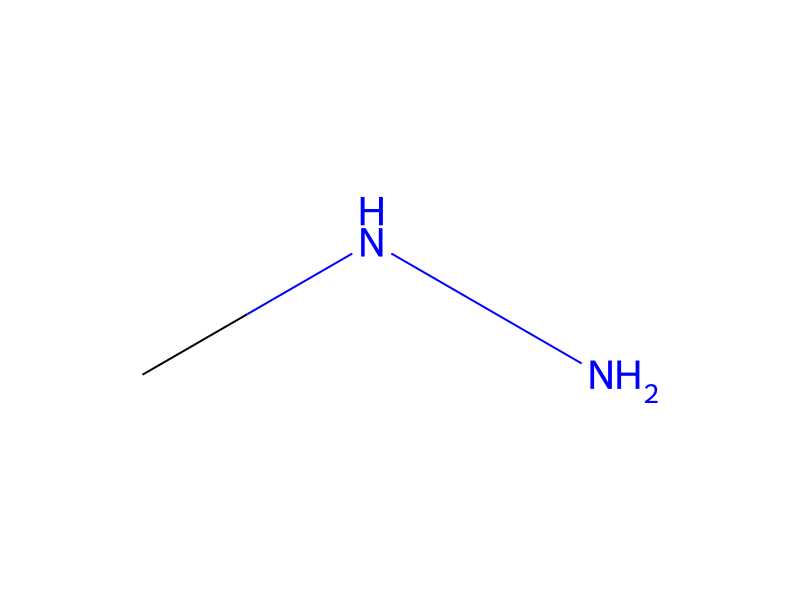
Methylhydrazine → 3,5-Dibromoisonicotinaldehyde methylhydrazone
Reaction equation

[Br:1][C:2]1[CH:3]=[N:4][CH:5]=[C:6]([Br:10])[C:7]=1[CH:8]=O.[CH3:11][NH:12][NH2:13]>>[Br:1][C:2]1[CH:3]=[N:4][CH:5]=[C:6]([Br:10])[C:7]=1/[CH:8]=[N:13]/[NH:12][CH3:11]Participants
3


Conditions
- Temperature
- 100 °C
Procedure
In analogy to GP 1, 2.15 g of 3,5-dibromo-pyridine-4-carbaldehyde (8.12 mmol, 1 eq; commercially available or prepared as described in U.S. Pat. No. 6,232,320 or WO2005110410) were dissolved in 36 mL 1-propyl alkohol, treated with 0.65 mL N-methyl hydrazine (12.17 mmol, 1.5 eq.) and heated to 100° C. for 30 min (employing a Biotage Initiator® microwave oven in batch mode). The reaction mixture was concentrated, the residue partitioned between water and ethyl acetate, the aqueous layer reextracted with ethyl acetate, the combined organic layers dried and concentrated in vacuo to yield 2.29 g of the desired product (7.82 mmol, 96% yield), which was used in the subsequent cyclization without further purification steps.
Workup
- customcommercially available or prepared
- dissolution6,232,320 or WO2005110410) were dissolved in 36 mL 1-propyl alkohol
- concentrationThe reaction mixture was concentrated
- customthe residue partitioned between water and ethyl acetate
- customthe combined organic layers dried
- concentrationconcentrated in vacuo
Sources & evidence
- ORD record
- ord-f27e074a12354cc688ee584127db0f78
- Source dataset
- uspto-grants-2013_07
- Patent number
- US08481539B2
Reaction notes
Loading…