5-Fluoro-2-nitrophenol → 4-(5-fluoro-2-nitrophenoxy)tetrahydro-2H-pyran
Reaction equation

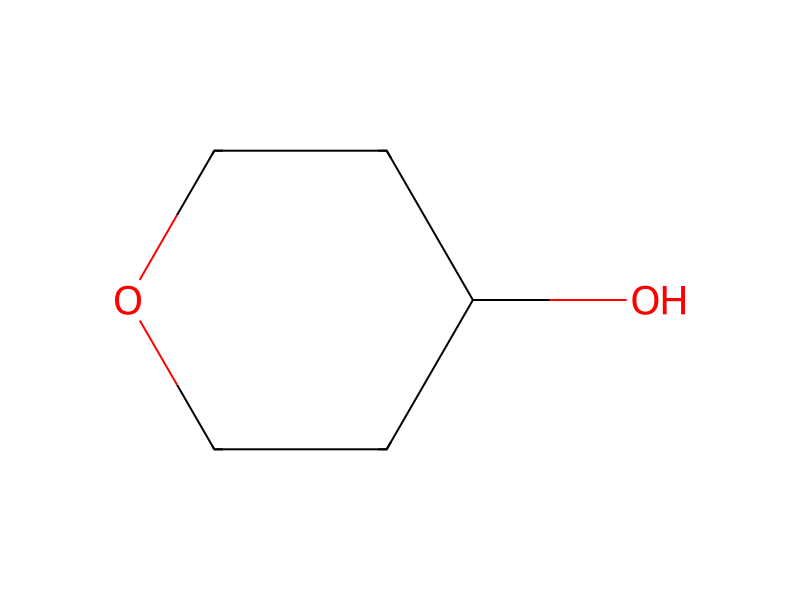
N(C(OC(C)(C)C)=O)=NC(OC(C)(C)C)=O.[F:17][C:18]1[CH:19]=[CH:20][C:21]([N+:25]([O-:27])=[O:26])=[C:22]([OH:24])[CH:23]=1.[O:28]1[CH2:33][CH2:32][CH:31](O)[CH2:30][CH2:29]1.C1(P(C2C=CC=CC=2)C2C=CC=CC=2)C=CC=CC=1>C(Cl)Cl>[F:17][C:18]1[CH:19]=[CH:20][C:21]([N+:25]([O-:27])=[O:26])=[C:22]([CH:23]=1)[O:24][CH:31]1[CH2:32][CH2:33][O:28][CH2:29][CH2:30]1Participants
6





Procedure
Di-tert-butyl azodicarboxylate (17.6 g, 76.4 mmol) was added into a solution of 5-fluoro-2-nitrophenol (10 g, 63.7 mmol), tetrahydro-2H-pyran-4-ol (7.3 mL, 76.4 mmol) and triphenyl phosphine (20 g, 76.4 mmol) in anhydrous DCM (120 mL) at 0° C. The solution was allowed to warm to ambient temperature overnight, concentrated in vacuo and the crude product triturated with n-pentane/diethyl ether (×2) to remove the triphenyl phosphine oxide (16.5 g) by-product. The sample was purified by flash column chromatography (5:1 petroleum ether (40-60° C.)/EtOAc) to yield yellow oil which was used in the next step directly.
Workup
- concentrationconcentrated in vacuo
- customthe crude product triturated with n-pentane/diethyl ether (×2)
- customto remove the triphenyl phosphine oxide (16.5 g) by-product
- customThe sample was purified by flash column chromatography (5:1 petroleum ether (40-60° C.)/EtOAc)
- customto yield yellow oil which
Sources & evidence
- ORD record
- ord-de97990ce20247a6867775d502d50954
- Source dataset
- uspto-grants-2013_07
- Patent number
- US08486953B2
Reaction notes
Loading…