2-Phenyl-2-propanol → Cumene
Reaction equation

[H][H].[C:3]1([C:9](O)([CH3:11])[CH3:10])[CH:8]=[CH:7][CH:6]=[CH:5][CH:4]=1>>[C:3]1([CH:9]([CH3:11])[CH3:10])[CH:8]=[CH:7][CH:6]=[CH:5][CH:4]=1Participants
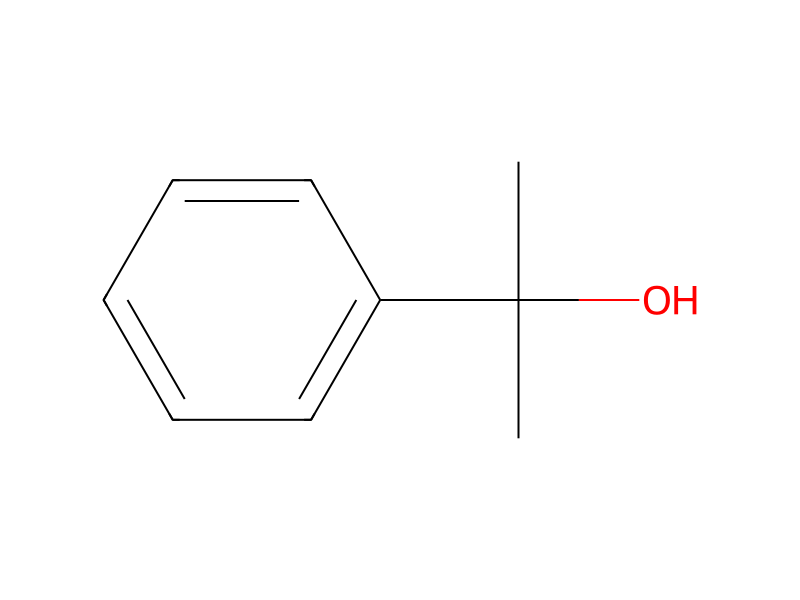

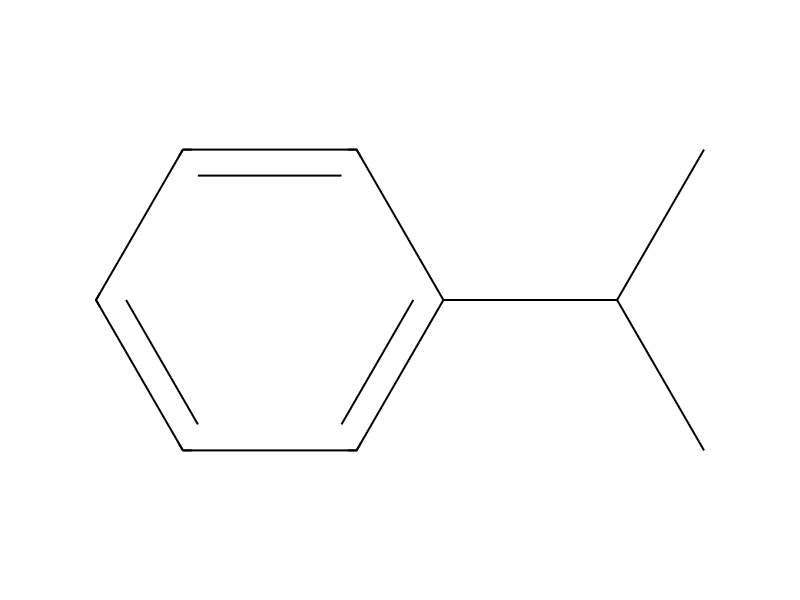
Procedure
The 6–20 mesh particles of reduced catalyst, prepared by the afore-mentioned procedure are loaded onto bed supports made of porous plate or screen in a distillation reactor in a nitrogen filled environment. Glass wool can also be used to support the catalyst particles. Hydrogen gas is added via a regulator to the apparatus to maintain a pressure between 0–450 psig, (typically between 0–150 psig). The flow rate is adjusted to maintain twice the amount of hydrogen required for the reaction stoichiometry. A feed stream containing alkylphenyl alcohol, such as a stream containing (e.g.10–40 weight %) of 2-phenyl-2-propanol (cumyl alcohol), is fed into the distillation reactor from below the catalyst beds. The bottom section of the distillation reactor is lowered into a heater and then the temperature is raised until the liquid refluxes in the distillation reaction zone containing the catalyst. Lower boiling alkylbenzene, such as cumene, and water are distilled out from the top of the column. Additional alkylphenyl alcohol, such as a cumyl alcohol-containing stream, is continually added with a slight molar excess of hydrogen to replace the amount of alkylphenyl alcohol, such as cumyl alcohol, that is converted to alkylbenzene, such as cumene, and distilled off. The alkyl benzene product, such as cumene, easily separates from the denser water phase. It is optionally dried further with molecular sieves or other suitable drying agents. The alkylbenzene, such as cumene, produced has a purity of more than 98 wt. %, preferably more than 99 wt. %. No measurable alkylphenyl alcohol, such as cumyl alcohol (<0.01 wt. %) is found in the alkylbenzene, such as cumene product. When desired, the bottoms can be removed, optionally diluted with cumene and sent to a fixed bed hydrogenation reactor to make additional alkyl benzene, such as cumene.
Workup
- customThe 6–20 mesh particles of reduced catalyst, prepared by the afore-mentioned procedure
- customsupports made of porous plate or screen in a distillation reactor in a nitrogen filled environment
- temperatureto maintain a pressure between 0–450 psig
- temperaturethe temperature is raised until the liquid refluxes in the distillation reaction zone
- additioncontaining the catalyst
- distillationsuch as cumene, and water are distilled out from the top of the column
- additionAdditional alkylphenyl alcohol, such as a cumyl alcohol-containing stream
- additionis continually added with a slight molar excess of hydrogen
- distillationdistilled off
- customIt is optionally dried further with molecular sieves
- customother suitable drying agents
Sources & evidence
- ORD record
- ord-fa5d11fd976a4645988bab2733801107
- Source dataset
- uspto-grants-2007_03
- Patent number
- US07193093B2
Reaction notes
Loading…