HuagongsheHuagongshe Chemistry Print Report · For research reference only
HRID 460366Generated: October 26, 2026
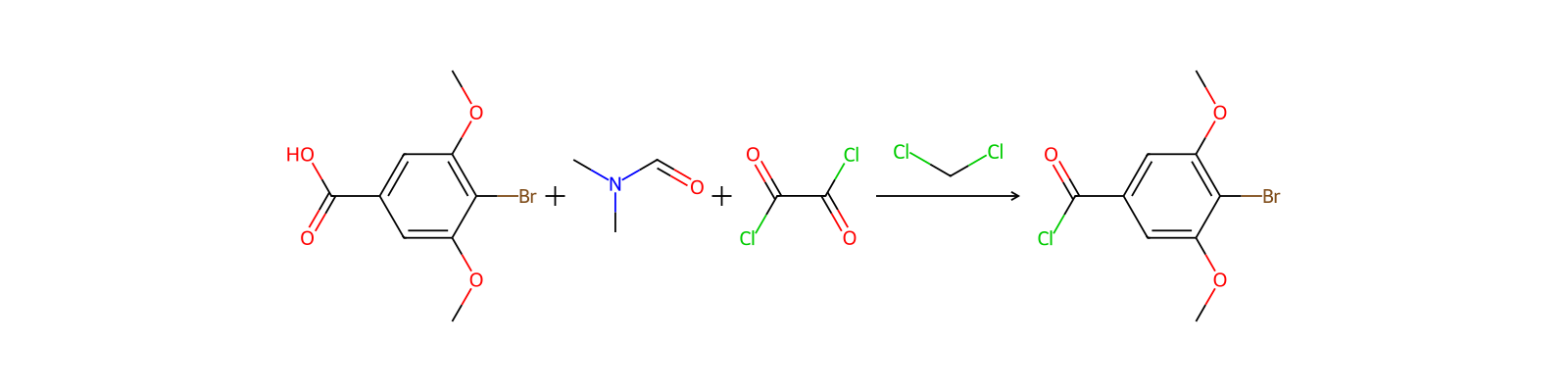
Dimethylformamide → 4-Bromo-3,5-dimethoxybenzoyl chloride
https://huagongshe.com/reaction/460366
Participants
| Role | Name | HCID | Charge |
|---|
| Reactant | Dimethylformamide | HCID 6228 | — |
| Reactant | Oxalyl chloride | HCID 65578 | — |
| Reactant | 4-Bromo-3,5-dimethoxybenzoic acid | HCID 2774026 | — |
| Solvent | Dichloromethane | HCID 6344 | — |
| Product | 4-Bromo-3,5-dimethoxybenzoyl chloride | HCID 22676867 | — |
Reaction Steps
To a solution of 4-bromo-3,5-dimethoxybenzoic acid (Acta Chem. Scand., 2, 34–41, (1948)) (22.6 g, 86.6 mmol) in methylene chloride (400 mL) was added dimethylformamide (1.5 mL, 19.4 mmol). Oxalyl chloride (13.0 g, 102.0 mmol) was gradually added to the ice-cold solution, and the mixture was stirred at room temperature for 1 hour and 30 minutes. The reaction mixture was concentrated under reduced pressure to yield crude crystals of 4-bromo-3,5-dimethoxybenzoyl chloride. To an ice-cold solution of 2-amino-2-methylpropanol (8.40 g, 94.2 mmol) in methylene chloride (100 mL) were added N,N-diisopropylethylamine (16.6 mL, 95.3 mmol) and a solution of the crude 4-bromo-3,5-dimethoxybenzoyl chloride in methylene chloride (200 mL). After the mixture was stirred at room temperature for 10 minutes, the mixture was washed successively with water, 8.0 M hydrochloric acid, a saturated aqueous sodium hydrogencarbonate and brine, dried over anhydrous sodium sulfate, and concentrated under reduced pressure. Thionyl chloride (47.5 mL, 651.0 mmol) was added to the residue, and the mixture was stirred at room temperature for 10 minutes. To the reaction mixture were added ice water and a 2.5 M aqueous sodium hydroxide (600 mL, 1500 mmol), and the mixture was extracted with diethyl ether. The organic layer was washed with brine, dried over anhydrous sodium sulfate, and concentrated under reduced pressure. The residue was recrystallized form diethyl ether-hexane to yield 2-(4-bromo-3,5-dimethoxyphenyl)-4,4-dimethyl-2-oxazoline as colorless fine needles (melting point: 172.5–174.5° C.) (20.9 g, yield: 77%).
Provenance & Evidence
| DOI | 10.6084/m9.figshare.5104873.v1 |
|---|
| Patent number | US07196101B2 |
|---|
| Source dataset | uspto-grants-2007_03 |
|---|
| ORD ID | ord-c61125b3d3314d1f815e0057e072fd27 |
|---|
| Source note | uspto-grants-2007_03 |
|---|