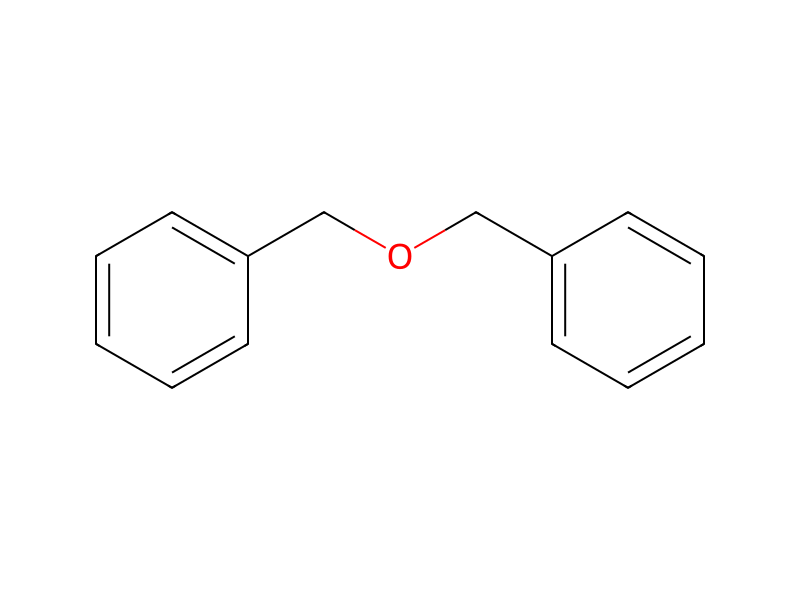
Sodium Chloride → Dibenzyl ether
Reaction equation

[CH2:1](Cl)[C:2]1[CH:7]=[CH:6][CH:5]=[CH:4][CH:3]=1.[OH-].[Na+].[C:11]([O-:14])(=O)[CH3:12].[Na+].[Cl-].[Na+]>S(=O)(=O)(O)[O-].C([N+](CCCC)(CCCC)CCCC)CCC>[CH2:1]([O:14][CH2:11][C:12]1[CH:6]=[CH:7][CH:2]=[CH:3][CH:4]=1)[C:2]1[CH:7]=[CH:6][CH:5]=[CH:4][CH:3]=1Participants
6
Reactant 4




Product 1
Reagents, catalysts & solvents 1

Conditions
- Temperature
- 60 °C
Procedure
Benzyl chloride (12.6 g; 0.1 mole), a 50 percent aqueous solution of sodium hydroxide (35 g; 0.44 mole), tetra-n-butylammonium bisulfate (1.7 g. 0.005 mole), and sodium acetate (0.4 g; 0.005 mole) were added to a reaction vessel fitted with a thermometer and magnetic stirrer. The contents were then stirred and heated to 60° C. The reaction was slightly exothermic raising the temperature of the reaction mass to 63° C. The reaction mass was sampled at various intervals and the samples were analyzed by gas-liquid chromatography. The results are tabulated in Table I. Upon completion of the reaction, the reaction mass consisted of a lemon yellow organic layer, a heavy, caustic emulsion and solid sodium chloride on the flask bottom.
Workup
- customfitted with a thermometer and magnetic stirrer
- temperatureThe reaction was slightly exothermic raising the temperature of the reaction mass to 63° C
- aliquotThe reaction mass was sampled at various intervals
- customUpon completion of the reaction
Sources & evidence
- ORD record
- ord-0008f55326ef4bd6b394002950ee1cbf
- Source dataset
- uspto-grants-1977_12
- Patent number
- US04061682
Reaction notes
Loading…