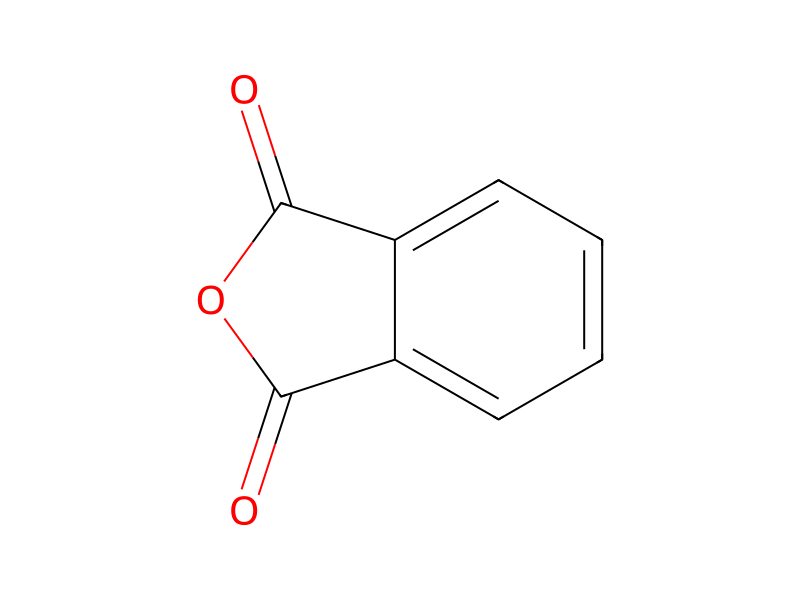
Naphthalene → Phthalic Anhydride
Reaction equation

C1C2C(=CC=CC=2)C=CC=1.C1C=CC2C(=O)C=CC(=O)C=2C=1.[C:23]([OH:34])(=[O:33])[C:24]1[C:25](=[CH:29][CH:30]=[CH:31][CH:32]=1)[C:26]([OH:28])=O.C(O)(=O)/C=C\C(O)=O.C(O)(=O)CCC(O)=O>[O-2].[O-2].[O-2].[O-2].[O-2].[V+5].[V+5]>[C:26]1(=[O:28])[O:34][C:23](=[O:33])[C:24]2=[CH:32][CH:31]=[CH:30][CH:29]=[C:25]12Participants
7
Reactant 5


Product 1
Reagents, catalysts & solvents 1

Procedure
The optimum yield of phthalic anyhdride is produced in the temperature range of 360° ± 10° C, with temperatures over or under this range resulting in over or under oxidation, respectively, of the napthalene yielding undesirable products such as 1-4 napthoquinone, phthalic acid, maleic acid, succinic acid, etc. With a vanadium pentoxide catalyst structure made according to the present invention, a yield of 99% phthalic anhydride was obtained with only a slight trace of 1-4 napthoquinone. Throughout this reaction, the temperature of the catalyst structure was easily maintainable within the optimum operating temperature range of 360° C ± 10° C.
Workup
- customThe optimum yield of phthalic anyhdride is produced in the temperature range of 360° ± 10° C, with temperatures over or under this range
- customresulting in over or under oxidation
Sources & evidence
- ORD record
- ord-9c7841d5250b4b158d7b59a13727c286
- Source dataset
- uspto-grants-1977_12
- Patent number
- US04062872
Reaction notes
Loading…