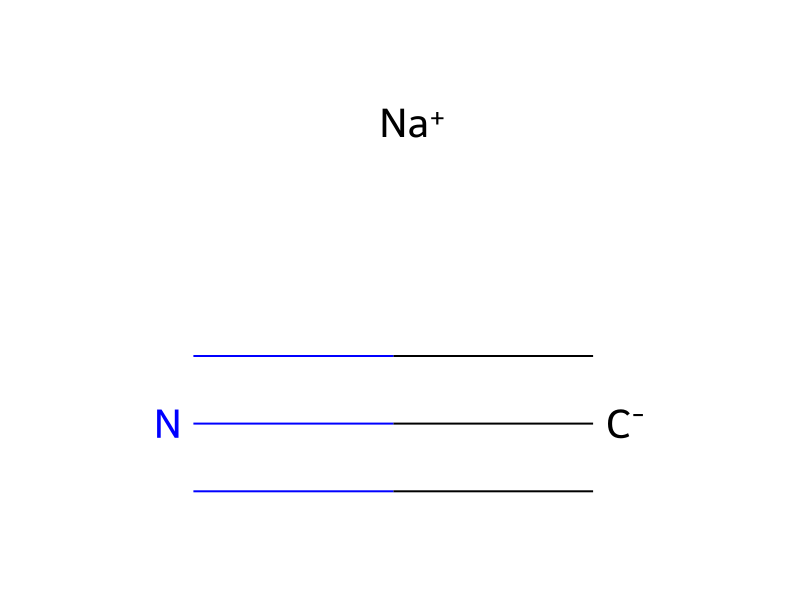
Sodium Cyanide → 2-(4-(Thien-2-ylcarbonyl)phenyl)propiononitrile
Reaction equation

[C-:1]#[N:2].[Na+].[S:4]1[CH:8]=[CH:7][CH:6]=[C:5]1[C:9]([C:11]1[CH:16]=[CH:15][C:14]([CH:17](Cl)[CH3:18])=[CH:13][CH:12]=1)=[O:10]>CS(C)=O>[C:5]1([C:9]([C:11]2[CH:16]=[CH:15][C:14]([CH:17]([CH3:18])[C:1]#[N:2])=[CH:13][CH:12]=2)=[O:10])[S:4][CH:8]=[CH:7][CH:6]=1Participants
4
Reactant 2

Product 1

Reagents, catalysts & solvents 1

Conditions
- Temperature
- 60 °C
Procedure
A suspension of 4.9 parts of sodium cyanide in 55 parts of dimethyl sulfoxide is stirred while heating to 60° C. Then there are added at once 8.5 parts of p-(1-chloroethyl)phenyl 2-thienyl ketone and stirring at 60° C is continued for 4h.30. The reaction mixture is poured onto water and the product is extracted with ether. The organic layer is washed with water, dried, filtered and evaporated, yielding p-(2-thenoyl)hydratroponitrile as a residue.
Workup
- stirringstirring at 60° C
- additionThe reaction mixture is poured onto water
- extractionthe product is extracted with ether
- washThe organic layer is washed with water
- customdried
- filtrationfiltered
- customevaporated
Sources & evidence
- ORD record
- ord-348ce5fcd50841ac96e4dac0f7de5e5d
- Source dataset
- uspto-grants-1977_12
- Patent number
- US04064132
Reaction notes
Loading…