Epichlorohydrin → HCID 20398516, compound
Reaction equation
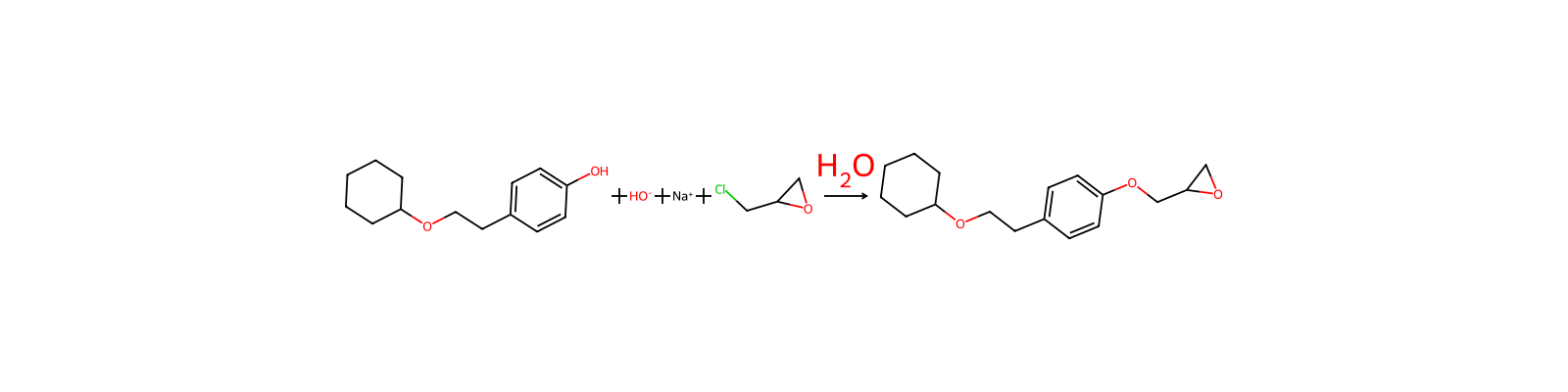
[CH:1]1([O:7][CH2:8][CH2:9][C:10]2[CH:15]=[CH:14][C:13]([OH:16])=[CH:12][CH:11]=2)[CH2:6][CH2:5][CH2:4][CH2:3][CH2:2]1.[OH-].[Na+].[CH2:19]([CH:21]1[O:23][CH2:22]1)Cl>O>[CH:1]1([O:7][CH2:8][CH2:9][C:10]2[CH:11]=[CH:12][C:13]([O:16][CH2:19][CH:21]3[O:23][CH2:22]3)=[CH:14][CH:15]=2)[CH2:6][CH2:5][CH2:4][CH2:3][CH2:2]1Participants
5
Reactant 3



Product 1

Reagents, catalysts & solvents 1

Procedure
13.3 g (0.06 mol) of 4-(2-cyclohexyloxyethyl)-phenol, 3.04 (0.076 mol) of sodium hydroxide pellets and 50 cc of water are introduced into a round-bottomed flask. The mixture is stirred at ambient temperature and, when the solution has become homogeneous, 18.6 g (16 cc, 0.2 mol) of epichlorohydrin are introduced. The stirring is continued at ambient temperature for 16 hours. Extraction is carried out with diethyl ether and the organic phase is washed with water. It is dried over magnesium sulphate and the ether is driven off. This gives an oil, which is used directly in the next step.
Workup
- extractionExtraction
- washthe organic phase is washed with water
- dry with materialIt is dried over magnesium sulphate
- customThis gives an oil, which
Sources & evidence
- ORD record
- ord-56079e3662624cd6a11f316d7a176f86
- Source dataset
- uspto-grants-1985_05
- Patent number
- US04515814
Reaction notes
Loading…