Sodium Azide → 5-(2-Chloro-4-trifluoromethylphenoxy)-2-nitrophenyl azide
Reaction equation
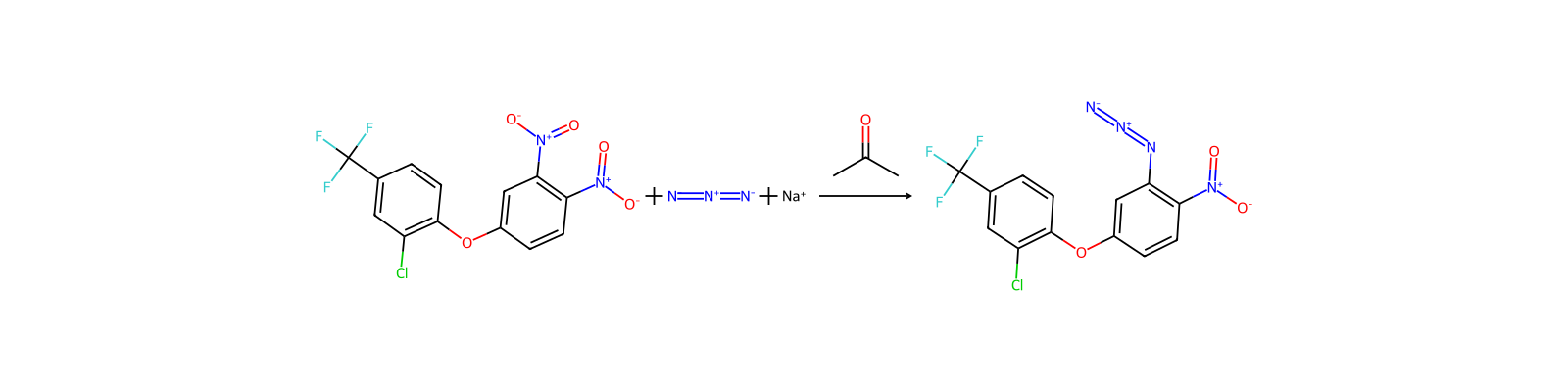
[Cl:1][C:2]1[CH:20]=[C:19]([C:21]([F:24])([F:23])[F:22])[CH:18]=[CH:17][C:3]=1[O:4][C:5]1[CH:10]=[CH:9][C:8]([N+:11]([O-:13])=[O:12])=[C:7]([N+:14]([O-])=O)[CH:6]=1.[N-:25]=[N+:26]=[N-].[Na+]>CC(C)=O>[Cl:1][C:2]1[CH:20]=[C:19]([C:21]([F:24])([F:23])[F:22])[CH:18]=[CH:17][C:3]=1[O:4][C:5]1[CH:10]=[CH:9][C:8]([N+:11]([O-:13])=[O:12])=[C:7]([N:14]=[N+:25]=[N-:26])[CH:6]=1Participants
4
Reactant 2


Product 1

Reagents, catalysts & solvents 1

Procedure
A mixture of 4-(2-chloro-4-trifluoromethylphenoxy)-1,2-dinitrobenzene (2.0 g, 5.5 mmol) and sodium azide (1.1 g, 16.6 mmol) in acetone (25 ml) is heated under reflux for 3.5 hours. The reaction is then cooled and filtered, and the filtrate is stripped. The residue is taken up in chloroform, washed with water (2X) and with brine, dried, stripped and purified by preparative thin layer chromatography (prep. TLC) (silica gel, eluting with 15% ethyl acetate/hexane) to give 5-(2-chloro-4-trifluoromethylphenoxy)-2-nitrophenyl azide.
Workup
- temperatureis heated
- temperatureunder reflux for 3.5 hours
- temperatureThe reaction is then cooled
- filtrationfiltered
- washwashed with water (2X) and with brine
- customdried
- custompurified by preparative thin layer chromatography (prep. TLC) (silica gel, eluting with 15% ethyl acetate/hexane)
Sources & evidence
- ORD record
- ord-6be467e2eaa24931ab7484da4a7a0218
- Source dataset
- uspto-grants-1985_10
- Patent number
- US04544400
Reaction notes
Loading…