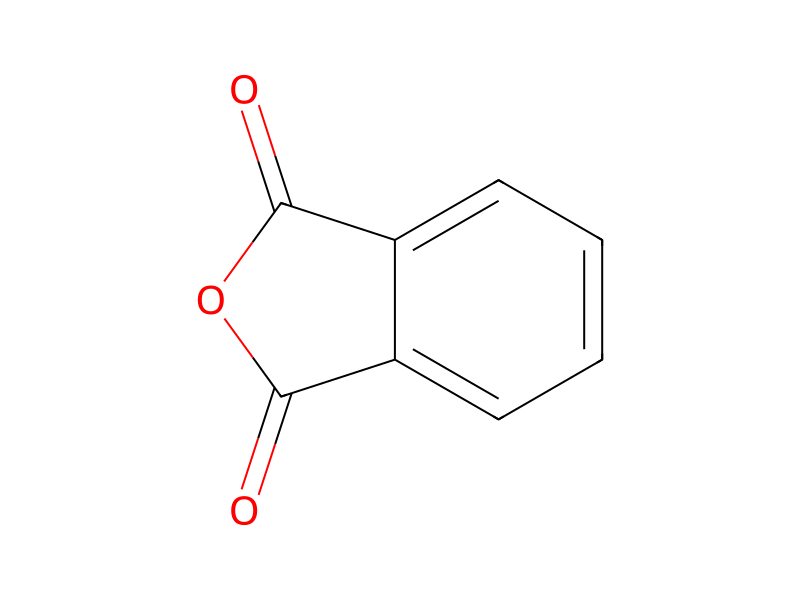
Phthalic Anhydride → Naphthalene
Reaction equation

[CH:1]1[CH:2]=[CH:3][C:4]2[C:11](=[O:12])[CH:10]=[CH:9][C:7](=[O:8])[C:5]=2[CH:6]=1.[C:13]1(=[O:23])[O:18][C:16](=[O:17])[C:15]2=CC=CC=[C:14]12>>[CH:6]1[C:5]2[C:4](=[CH:11][CH:10]=[CH:9][CH:7]=2)[CH:3]=[CH:2][CH:1]=1.[CH:2]1[CH:1]=[CH:6][C:5]2[C:7](=[O:8])[CH:9]=[CH:10][C:11](=[O:12])[C:4]=2[CH:3]=1.[C:16]1(=[O:17])[O:18][C:13](=[O:23])[CH:14]=[CH:15]1Participants
5


Procedure
By the process according to the present invention it has surprisingly been possible to obtain a colorless, pure phthalic anhydride with a melting point of 131.2° C., a naphthoquinone content of less than 1 ppm, and a color value of less than 10 APHA. These surprising results have been obtained by heating crude phthalic anhydride produced from naphthalene containing 0.7-0.8% by weight of naphthoquinone and 0.04% by weight of maleic anhydride, for 20 hours with, for example, 0.2% by weight of commercial polybutadiene oils to about 240° C., followed by vacuum distillation. Similar results were obtained with the use of polyisoprene, polydimethylbutadiene, and poly-1,3-pentadiene.
Workup
- customThese surprising results
- customhave been obtained
Sources & evidence
- ORD record
- ord-85564bf7d67f433ab1c99a3dc119285e
- Source dataset
- uspto-grants-1985_10
- Patent number
- US04547578
Reaction notes
Loading…