1,3,4-Thiadiazole, 2-amino-5-methyl- → HCID 15158115, compound
Reaction equation

Br[CH2:2][C:3]([C:5]1[C:6]([C:14]2[CH:19]=[CH:18][CH:17]=[CH:16][CH:15]=2)=[N:7][N:8]2[CH:13]=[CH:12][CH:11]=[CH:10][C:9]=12)=O.[NH2:20][C:21]1[S:22][C:23]([CH3:26])=[N:24][N:25]=1>C(O)CCC>[CH3:26][C:23]1[S:22][C:21]2=[N:20][C:3]([C:5]3[C:6]([C:14]4[CH:19]=[CH:18][CH:17]=[CH:16][CH:15]=4)=[N:7][N:8]4[CH:13]=[CH:12][CH:11]=[CH:10][C:9]=34)=[CH:2][N:25]2[N:24]=1Participants
Reactant 2

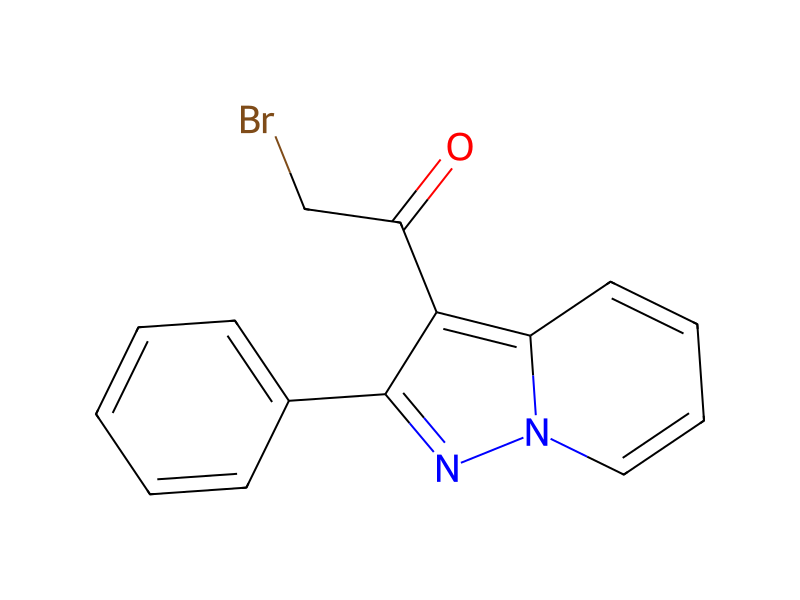
Product 1

Reagents, catalysts & solvents 1

Procedure
A mixture of 3-(2-bromoacetyl)-2-phenylpyrazolo[1,5-a]pyridine (1.87 g), 2-amino-5-methyl-1,3,4-thiadiazole (0.68 g) and 1-butanol (19 ml) was refluxed for 5 hours and 20 minutes. The reaction mixture was evaporated in vacuo and the residue was taken up methylene chloride (40 ml). The methylene chloride solution was washed with an aqueous solution of potassium carbonate and dried over magnesium sulfate. The solvent was removed and the residue was subjected to chromatography on silica gel (25 g) with chloroform as an eluent. The fractions containing the objective compound were combined and evaporated in vacuo to give 3-(2-methylimidazo[2,1-b][1,3,4]thiadiazol-6-yl)-2-phenylpyrazolo[1,5-a]pyridine (1.06 g), which was recrystallized from acetone gave crystals (0.69 g).
Workup
- temperaturewas refluxed for 5 hours and 20 minutes
- customThe reaction mixture was evaporated in vacuo
- washThe methylene chloride solution was washed with an aqueous solution of potassium carbonate
- dry with materialdried over magnesium sulfate
- customThe solvent was removed
- additionThe fractions containing the objective compound
- customevaporated in vacuo
Sources & evidence
- ORD record
- ord-7d73967641bf41eba31078a1b0c1ba42
- Source dataset
- uspto-grants-1992_10
- Patent number
- US05155114
Reaction notes
Loading…