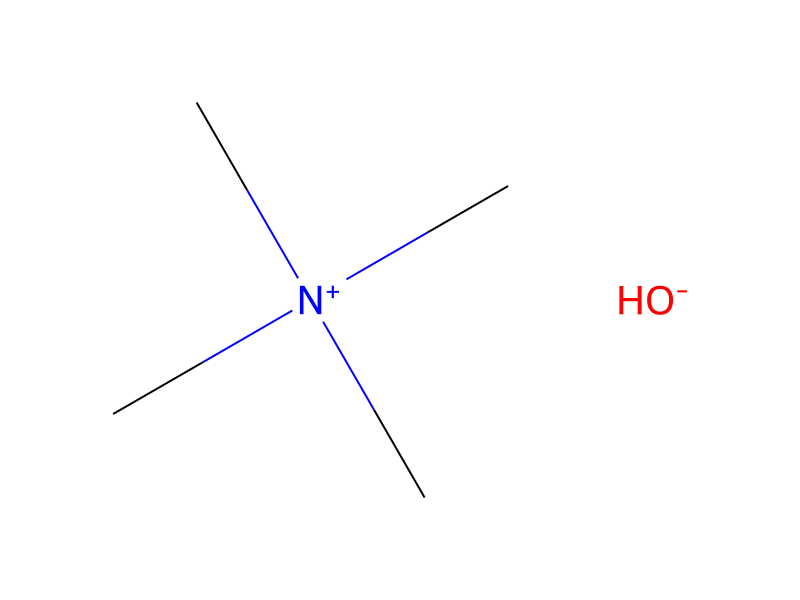
Tetramethylammonium hydroxide → HCID 70052379, compound
Reaction equation

[P:1]([O-:18])([O:10]CC1C=CC=CC=1)[O:2][CH2:3][C:4]1[CH:9]=[CH:8][CH:7]=[CH:6][CH:5]=1.[OH-].[CH3:20][N+:21]([CH3:24])([CH3:23])[CH3:22]>C(#N)C.O>[CH2:3]([O:2][P:1]([O-:18])[O-:10])[C:4]1[CH:9]=[CH:8][CH:7]=[CH:6][CH:5]=1.[CH3:20][N+:21]([CH3:24])([CH3:23])[CH3:22].[CH3:20][N+:21]([CH3:24])([CH3:23])[CH3:22]Participants
Reactant 2

Product 1

Reagents, catalysts & solvents 2


Procedure
Dibenzyl phosphite (29.4 g, 112 mmol) is dissolved in a mixture of acetonitrile (140 mL) and water (30 mL) and the reaction mixture is treated with 2.8M aqueous tetramethylammonium hydroxide (40 mL, 112 mmol) at room temperature for 24 hours. After being washed with ether (3×20 mL), the aqueous layer is concentrated in vacuo. The residue is dried under high vacuum at 70° for 12 hours to yield tetramethylammonium benzyl phosphite as a semi-solid. The latter compound (2 g, 8 mmol) and α-(phenylacetoxy)isobutyl bromide (prepared from phenylacetyl bromide and isobutyraldehyde according to Helv. Chim. Acta 61, 2047, 1978) (1.26 mL, 8 mmol) are stirred in acetone (15 mL) for 18 hours at room temperature. The precipitate is filtered through Celite. The filtrate is concentrated under reduced pressure and purified by flash-chromatography on silica gel eluting with 37.5% of ethyl acetate in hexane. Evaporation of the pure fractions gives the unsymmetrical (α-phenylacetyloxyisobutyl) benzyl phosphite as a colorless oil.
Workup
- washAfter being washed with ether (3×20 mL)
- concentrationthe aqueous layer is concentrated in vacuo
- customThe residue is dried under high vacuum at 70° for 12 hours
Sources & evidence
- ORD record
- ord-34a08bf3570e4819a05f95b4e9c02127
- Source dataset
- uspto-grants-1992_10
- Patent number
- US05155100
Reaction notes
Loading…