Participants
| Role | Name | HCID | Charge |
|---|
| Reactant | Formaldehyde | HCID 712 | — |
| Reactant | Pyrrolidine | HCID 31268 | — |
| Reactant | 1,3-Dihydro-1-methyl-3-(2-propyn-1-yl)-2H-imidazol-2-one | HCID 15065505 | — |
| Solvent | 1,4-Dioxane | HCID 31275 | — |
| Product | HCID 15065517 | HCID 15065517 | — |
Reaction Steps
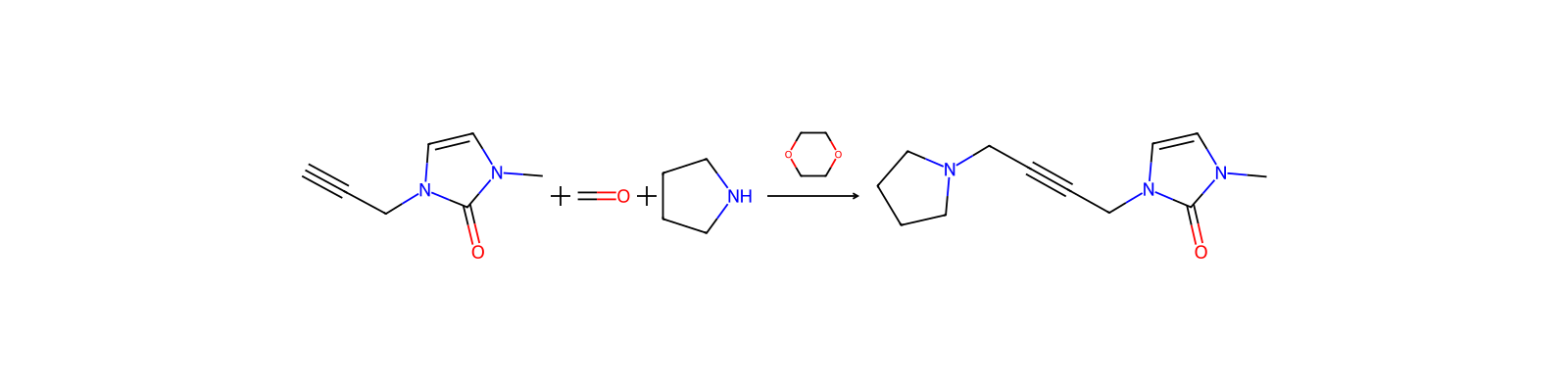
The intermediate imidazolidinones and imidazolones were converted to the final products using the general procedures outlined in Scheme 2. 1,3-dihydro-1-methyl-3-(2-propynyl)-2H-imidazol-2-one was reacted with paraformaldehyde and pyrrolidine in dioxane using cuprous chloride as catalyst to give 1,3-dihydro-1-methyl-3-[4-(1-pyrrolidinyl)-2-butynyl]-2H-imidazol-2-one. The diethylamine analogue was prepared similarly and was reacted with cyanogen bromide to give the bromide XI which was reacted with imidazole to give 1,3-dihydro-1-[4-(1H-imidazol-1-yl)-2-butynyl]-3-methyl -2H-imidazol-2-one and with 1-acetyl-4-methylimidazole to give XII which was hydrolyzed to 1,3-dihydro-1-methyl-3-[4-(5-methyl-1H-imidazol-1-yl)-2-butynyl]-2H-imidazol-2-one. The imidazolidinone analogues of Table 1, imidazolones of Table 2 and immidazolidinedione and tetrahydropyrimidinones of Table 3 were prepared by these general procedures.
Provenance & Evidence
| DOI | 10.6084/m9.figshare.5104873.v1 |
|---|
| Patent number | US05157124 |
|---|
| Source dataset | uspto-grants-1992_10 |
|---|
| ORD ID | ord-2335ca88811f40acb78462dfee6cda1c |
|---|
| Source note | uspto-grants-1992_10 |
|---|