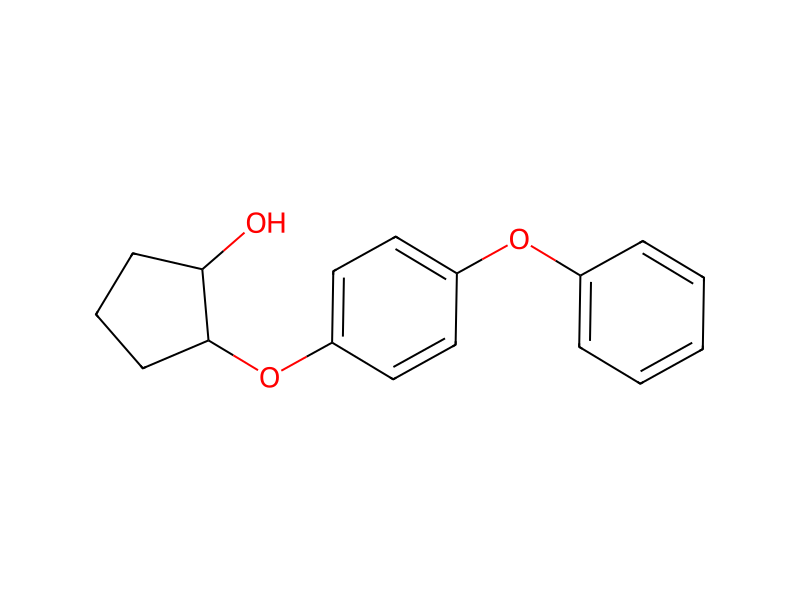
Sodium borohydride → 2-(4-Phenoxyphenoxy)cyclopentan-1-ol
Reaction equation

[BH4-].[Na+].[O:3]([C:10]1[CH:22]=[CH:21][C:13]([O:14][CH:15]2[CH2:19][CH2:18][CH2:17][C:16]2=[O:20])=[CH:12][CH:11]=1)[C:4]1[CH:9]=[CH:8][CH:7]=[CH:6][CH:5]=1>O.CO>[O:3]([C:10]1[CH:22]=[CH:21][C:13]([O:14][CH:15]2[CH2:19][CH2:18][CH2:17][CH:16]2[OH:20])=[CH:12][CH:11]=1)[C:4]1[CH:5]=[CH:6][CH:7]=[CH:8][CH:9]=1Participants
5
Reactant 2


Product 1
Reagents, catalysts & solvents 2


Procedure
A solution of 3.78 g of sodium borohydride in 10 ml of water is added at room temperature to a solution of 8.04 g of 2-(4-phenoxyphenoxy)-cyclopentan-1-one in 60 ml of methanol. The reaction mixture is stirred for 15 hours at room temperature and then concentrated under reduced pressure. The residue is poured into ice-water and extracted with ether. The organic phase is washed twice with saturated sodium chloride solution, dried over sodium sulphate and concentrated by rotary evaporation. Fractional distillation of the residue yields 2-(4-phenoxyphenoxy)-cyclopentan-1-ol as a colourless oil with a boiling point of 181°-185° C./0.001 torr.
Workup
- concentrationconcentrated under reduced pressure
- additionThe residue is poured into ice-water
- extractionextracted with ether
- washThe organic phase is washed twice with saturated sodium chloride solution
- dry with materialdried over sodium sulphate
- concentrationconcentrated by rotary evaporation
- distillationFractional distillation of the residue
Sources & evidence
- ORD record
- ord-2ef5f5af53484609ab6d59ece6adafd5
- Source dataset
- uspto-grants-1979_11
- Patent number
- US04175137
Reaction notes
Loading…