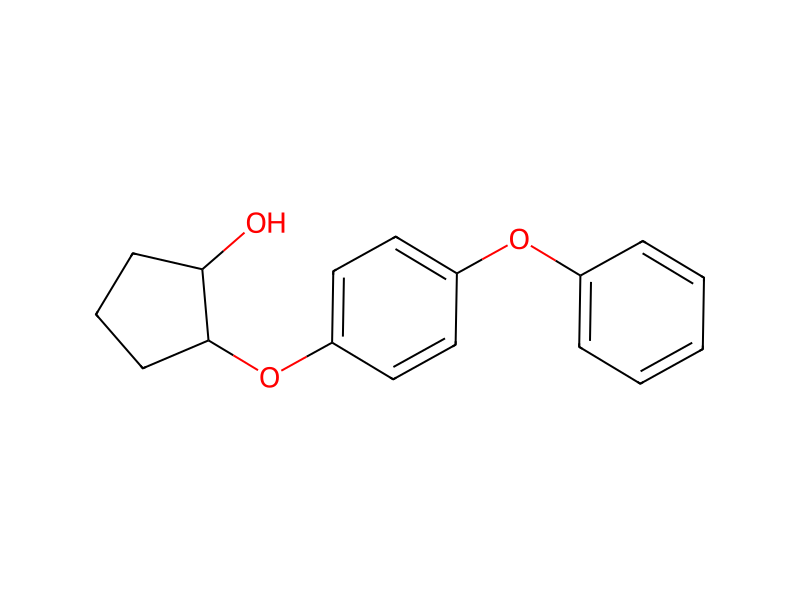
Potassium Hydroxide → 2-(4-Phenoxyphenoxy)cyclopentan-1-ol
Reaction equation

[OH-].[K+].C([O:6][CH:7]1[CH2:11][CH2:10][CH2:9][CH:8]1[O:12][C:13]1[CH:18]=[CH:17][C:16]([O:19][C:20]2[CH:25]=[CH:24][CH:23]=[CH:22][CH:21]=2)=[CH:15][CH:14]=1)(=O)C>O.C(O)C>[O:19]([C:16]1[CH:17]=[CH:18][C:13]([O:12][CH:8]2[CH2:9][CH2:10][CH2:11][CH:7]2[OH:6])=[CH:14][CH:15]=1)[C:20]1[CH:21]=[CH:22][CH:23]=[CH:24][CH:25]=1Participants
5
Reactant 2


Product 1
Reagents, catalysts & solvents 2


Procedure
A solution of 1.68 g of potassium hydroxide in 20 ml of water is added at room temperature to a solution of 6.24 g of 1-acetoxy-2-(4-phenoxyphenoxy)-cyclopentane in 50 ml of ethanol. The mixture is then refluxed for 3 hours and, after cooling, concentrated to 166 of its original volume by rotary evaporation. The residue is poured into ice-water. After extraction with ether, the organic phase is washed three times with saturated sodium chloride solution, dried over sodium sulphate and concentrated by rotary evaporation. Distillation of the residue yields 2-(4-phenoxyphenoxy)-cyclopentan-1-ol as a colourless oil with a boiling point of 181°-185° C./0.001 torr.
Workup
- temperatureThe mixture is then refluxed for 3 hours
- temperatureafter cooling
- concentrationconcentrated to 166 of its original volume by rotary evaporation
- additionThe residue is poured into ice-water
- extractionAfter extraction with ether
- washthe organic phase is washed three times with saturated sodium chloride solution
- dry with materialdried over sodium sulphate
- concentrationconcentrated by rotary evaporation
- distillationDistillation of the residue
Sources & evidence
- ORD record
- ord-f0616c2b746642858f6b65dc1ecff7f3
- Source dataset
- uspto-grants-1979_11
- Patent number
- US04175137
Reaction notes
Loading…